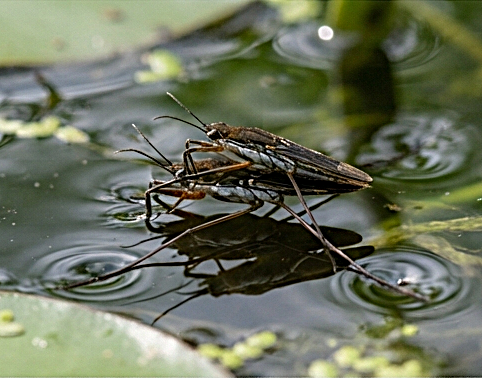

Gerridae-Water Skaters
- Neuston, also called ‘Pleuston’ are organism that live at the surface of a body of water. They can live on top of the water surface or submerged just below the water surface.
- The Gerridae are a family of insects of the order Hemiptera, suborder Heteroptera, bugs with mouth parts evolved for piercing and sucking. A distinguishing feature amongst them is the ability to move on top of the water surface. Almost 1400 species of Gerridae have been described. With an evolutionary history of almost 140 million years tracing to the early cretaceous period, Gerrids have been described to possess small hydrophobic micro hairs (almost one thousand micro hairs per millimetre). These hairs provide the insects the resistance to impacts from splashes or drops of water. They repel the water, preventing drops from weighing down the body.
- Striders can move on the surface of a body of water using the surface tension of water. The long hydrophobic legs repel water and also help to distribute the weight. The middle legs are used for rowing, the hind legs are used for steering and the fore legs help in feeding by attaching and holding on to prey. The body of the strider is also covered with dense tiny hydrophobic hair which help in repelling water and prevent from wetting due to rain, droplets or spray which could have the potential to weigh down the body and inhibit the ability of the insect to keep its entire body over the surface of the water. This capacity of the Gerridae to skate on the surface of water is also referred to as epi-pleustonic. If the body of the insect gets accidentally submerged the tiny hair would trap the air and provided the needed buoyancy. The trapped air would also provide for air bubbles to breathe under water. Oil spillages and polluted waters may make them immobile and cause death.
©Srimaa Communication
Credits- Dr. Yashpal Singh, Mrs. Neena Singh, Mr. Rajesh Bedi, Manoj Kumar Yadav