
Rainbow Lorikeet (Trichoglosssus moluccanus)
In high demand as a pet and selling almost as high as seventeen hundred dollars, this beautiful bird is a native of Australia. The type locality has been reported as the Botany Bay, Sydney. This was the entry point of Captain James Cook when he first landed in Australia in 1770 AD. Taxonomically referenced as Trichoglosssus moluccanus, it is also called the Rainbow Lorikeet, possibly because of being endowed with almost all colours of the rainbow.
The rainbow lorikeet is one of the most commonly found lorikeets in Australia. Mostly considered a pest it is widely distributed in the Eastern Seas from North Queensland to south Australia. Outside of Australia it is found in Tasmania, New Zealand and Hong Kong where it has been artificially introduced by aviary releases. A local population in Perth (WA) has also been reported. This has also been initiated by aviary releases. It was illegally released in Auckland in Nineteen Ninety and is now a threat to New Zealand’s native wild life. It is an unwanted species in New Zealand under the Biodiversity Act of 1993.
They inhabit rainforests, coastal bush and wood land areas and have also adapted to well planted urban areas
It is a medium sized parrot, about twenty-five to thirty centimetres in length from head to tail and weights about seventy-five to one hundred and fifty grams. The plumage is bright and colourful with a deep blue head, a greenish yellow collar, green upper parts and an orange yellow chest. The belly is deep blue. The thighs and rump are green. In flight a yellow wing bar contrasts clearly with the red under wing covers. The juveniles have a black beak which gradually becomes orange in adults. The birds bear a close resemblance to the coconut lorikeet but has discernible differences.
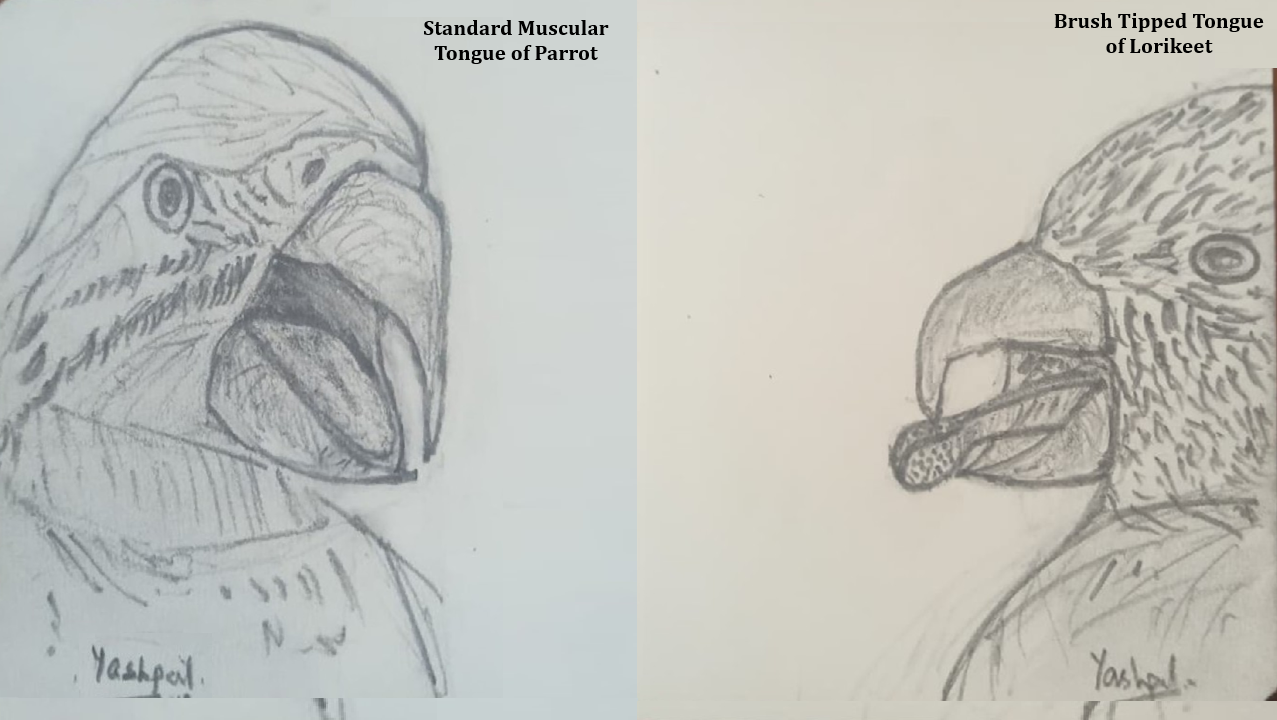
All Lorikeets are Parrots but all parrots are not Lorikeets. Parrots have a standard muscular tongue but Lorikeets have a unique brush tipped tongue covered with papillate hairs. This brush tipped tongue helps it to soak in nectar and feed on pollen. This is its staple diet. As the Lorikeet dips its tongue into a flower, the papillae flare outwards, the tongue acts as a brush and the papillae act collectively as a sponge. The feed mixed with mucous, to ensure smooth passage, is then transported to the throat through fine grooves in the tongue which act as channels. A close examination of the clips may show some birds with mucous dangling from the beaks.
The rainbow lorikeet is generally a vegetarian but has also been observed to be feeding on leftover pieces of meat sometimes. This is not good for a bird which is primarily a vegetarian. The rainbow lorikeet with a brush like, papillate tongue, feeds mostly on the flowers of shrubs or trees to harvest nectar and pollen. It also eats fruits and some insects. The tongue is specific to lorikeets. The diet is primarily liquid and the excreta is also mostly liquid. Being nectar and pollen feeders, they are natural pollinators. They exhibit nomadism and follow the flowering season of the eucalyptus trees up and down the coast of Australia.
Being the smallest of the lorikeets they may live up to 12 years in the wild and almost 25 years in captivity. Sexes are alike. They are monogamous and may pair for life. The male and female roost together but only the female sits on the two small white eggs. The male helps in feeding the chicks. The Eggs are laid in trees hollows and young birds stay with their parents for several weeks before becoming independent.
A not too clearly understood phenomena in the Rainbow lorikeets is the Lorikeet Paralysis syndrome. Hundreds of birds are literally falling from the sky every day. Scientists do not know why.
Birds may often appear drunk. This behaviour in lorikeets is not uncommon. It could be due to a virus combined with ingesting alcohol from fermenting fruits. The associated respiratory problems and discharges from the nostrils, mouth and eyes suggest that the condition is more than simple drunkenness.
Inititally the birds may lose balance and are unable to fly. As the disease advances, the birds lose total control of their limbs and beaks. Ingestion of a toxin is being regarded as a cause but the same has yet to be identified. Fungal and bacterial sources are being examined. The problem is seasonal and extends from October to June with the highest incidence from December to February.
At sunset, rainbow lorikeets may gather in large communal roosts when hundreds of birds call loudly before settling for the night.
Credits- Dr. Yashpal Singh, Mrs. Neena Singh, and Mr. Manoj Kumar Yadav