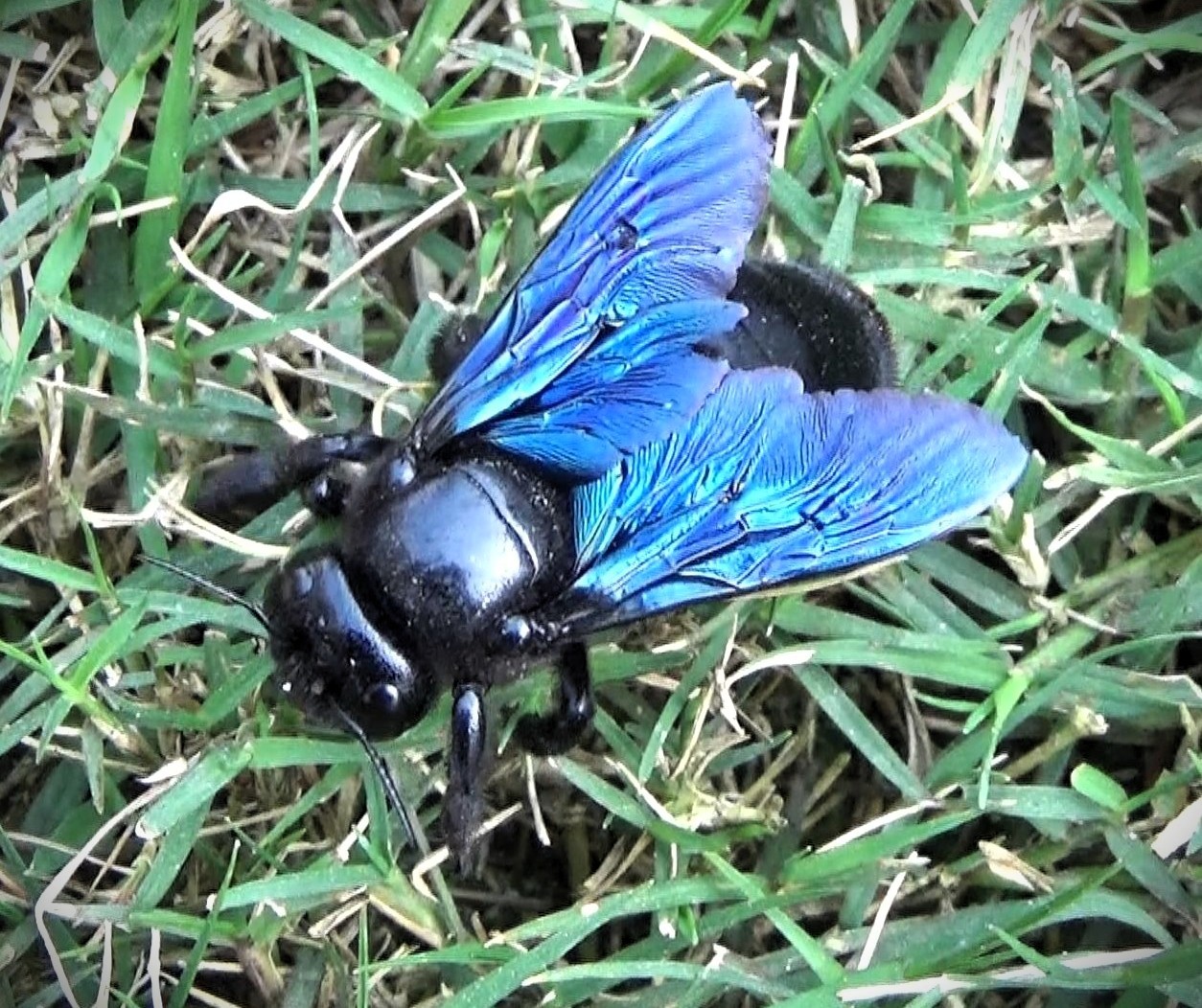

Carpenter Bees. Haplo-Diploploidy and the Ability of Females to Select the Sex of their Offsprings- Xylocopa latipes
Carpenter bees are Bees in the Genius Xylocopa which has about 500 different bees in 31 subgenera. X. latipes and X. violacea are both large, solitary, non-aggressive wood boring bees differing primarily in geography and appearance.
- latipes is found in southeast Asia and has a purely black body with metallic blue/green wings and is significantly larger than X. Violacea which is nature to Europe and Asia and has violet/dark blue wings. Xylocopa latipes is mainly distributed through South East Asia. In India, it is found primarily in the northern regions. This specimen, identified as X. latipes was observed in November 2025 in a primarily residential area in the urban limits of Lucknow, Uttar Pradesh, India. Xylocopa latipes is amongst the largest Carpenter Bees known.
Within Carpenter Bees:
- Nearly all species burrow into hard plant material such as dead wood or Bamboo.
- Carpenter bees are often mistaken for Bumble bees. They can however be differentiated by the presence of a shiny abdomen. Bumble Bees, on the other hand, have a fuzzy abdomen.
- They are Buzz Pollinators and vibrate their flight muscles to release pollen from certain flowers.
- This specimen is actively preening itself which helps in cleaning antennal sensory pores and body hairs which are vital for detecting surroundings. It also helps in pathogen removal, prevents detritus from blocking spiracles (air ways) and helps in spreading antimicrobial compounds across the body.
- They are traditionally considered as solitary bees which forage, builds cellular tunnels, lay the eggs and guard the nests. Normally only one generation lives in a nest.
- Carpenter bees do not eat wood. They discard the pieces of wood or reuse the wood particles to make partitions between cells.
- The tunnel functions as a nursery for the brood and storage for the pollen/nectar upon which the brood subsists.
- Female carpenter bees are capable of stinging but rarely do so. (Unless caught in the hand or directly provoked). Males do not have a stinger and cannot sting.
- Carpenter Bees mate in flight.
- Female bees collect pollen and nectar for themselves and to be placed along with the egg in the cells for sustenance. Male bees collect only nectar which is solely used by them.
- Life Cycle
- Females use strong mandibles to excavate channels in wood and make cells.
- A single large egg is laid in a cell containing a pollen ball. The egg hatches in 7 to 10 days.
- The larva feeds on the Pollen ball, develops and pupates within the cell in 3 to 4 weeks.
- New adults emerge around 7 weeks after the egg is laid. They may stay in the nests for 2 to 3 weeks before emerging out for foraging.
- Males are Haploid and Females diploid. The Carpenter Bee females can select the sex of their offspring through haplo- diploidy. Fertilised eggs develop into females whereas unfertilised eggs develop into males.
- The female bee has a storage organ, the spermatheca for storage of sperm and can choose to either release the sperm (fertilise its eggs for a female) or withhold it (producing a male) when laying an egg in a brood cell. Mothers aften place male eggs near the entrance of the nest. Males hatch and leave earlier and the position of the male cell at the entrance of the nest allows them to leave the nest without disturbing the developing female larvae in the inner cells. They can also determine the amount pollen to be provided to each eggs affecting the size of the adult.
©Srimaa Communication
Credits- Dr. Yashpal Singh, Mrs. Neena Singh, Mr. Manoj Kumar Yadav