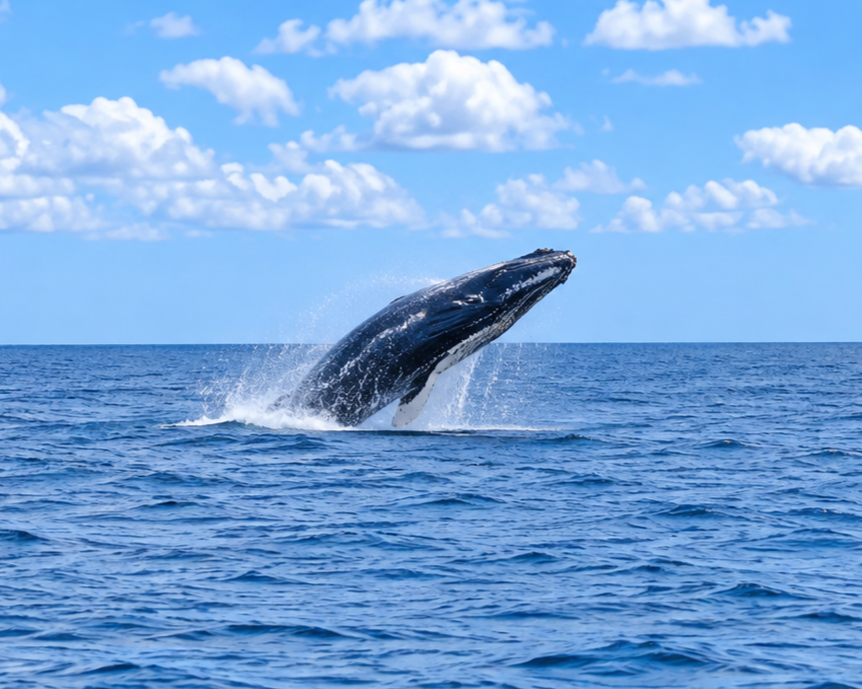

The Great Hump Back Whale Migration at Gold Coast, Australia
- Megaptera novaeangliae is the only species in the genus Megaptera and is a Baleen Whale.
- Baleen whales are marine Mammals that use Baleen plates in their mouths to sieve plankton from water.
- Adults range in length from 14 to 17 mts. and may weigh up to 40 tons. Females are usually 1 to 1.5 meters longer than the males.
- Males produce a complex song that lasts from 4 to 33 minutes.
- Distributed in oceans and seas around the world, they typically migrate between feeding areas which are near the poles and breeding areas near the equator.
- Their diet consists mostly of Krill and small fish and they usually use bubbles to catch prey.
- They are polygynandrous breeds with both sexes having multiple partners.
- The bodies host barnacles and white lice.
- With a dwindling population of about 5000 and on the brink of extinction in the 1960’s, conservation efforts have triggered an efficient recovery and now there are about 1.35 lakh individuals word wide.
- Entanglement in fishing gear, collision with ships and noise pollution are factors affecting the species.
- Calves are born at around 4.3 metres long with a mass of 680 kilogram.
- Humpbacks have bumps or tubercles on the head and front edge of the flippers. These tubercles are hollow and contain at least one fragile hair that grows 1 to 3 cm from the skin and is 0.1 mm thick. The tubercles develop early in gestation and may have a sensory function being rich in nerves. Sensory nerve cells in the skin are adapted to withstand the high-water pressure of diving.
- The eye sight is relatively poor. It can only see silhouettes over long distances and finer details relatively close.
- The respiratory tract is connected to the blow holes and not to the mouth. They can however blow bubbles from their mouths.
- Humpbacks are highly active at the surface performing aerial behaviours such as breaching, surface slapping and peduncle throws. They rest at the surface with their bodies lying horizontally. They may commonly explore depths of up to eighty metres and occasionally diving down to 616 mts. Dives do not exceed 05 minutes during the summer but could be 15 to 20 metres during winters.
- Humpback whales are generalist feeders. They swallow prey in bulk. Water is pushed out through the baleen.
- Production of bubbles just beneath the female genitalia by the males has been found to stimulate females.
- Gestation lasts about 11.5 months and the females reproduce every two years. Calves suckle for up to a year but can eat adult food in about 06 months.
- They are sexually mature at 5 to 15 years and live for over 50 years. It is one of the longest migrations for any animal.
- They are built to migrate. Their powerful tails provide slow steady thrusts driving them forward through the water. The pectoral fins are the largest of any whales. Humpbacks store massive amounts of fat before the migration. It serves as a warm jacket and also as a source of energy.
Credits- Dr. Yashpal Singh, Mrs. Neena Singh, and Mr. Manoj Kumar Yadav