
Cheetal – India’s Most beautiful Deer
Cheetal or spotted deer, taxonomically referred to as Axis axis is one of the most beautiful of all deer. It has a history of evolution from the late Miocene about 5 to seven million years ago. The first fossil records from India were discovered as early as the middle Pleistocene period about a million years ago. It is a native of the Indian subcontinent where it has adapted itself to the warm tropical climate. It has been introduced into the United States, Caribeans, Hawaii and Australia.
It has evolved the capacity to breed all the year round with local peaks coinciding with rains and food. Being a tropical species, it is very widely distributed in India and can be seen in almost any forested area. It is protected as a Schedule Three animal under the Wild life protection act in India and classified as a species of Least concern by the I.U.C.N
Chital live in groups ranging from small matriarchal herds with an adult female and her offsprings or in large mixed groups like this one. There may be all female or all male herds too. In a healthy herd, stags in hard antlers, pregnant or nursing females and fawns can appear throughout the year. Stags roam widely from herd to herd in search of oestrous females. They produce a shrill bellow when in heat. Bellowing marks the beginning of the breeding season.
Living in herds in an adaptation to protect from predation.
Chital is the preferred food for leopards Lions and Tigers and is also predated upon by crocodiles, rock pythons, wild dogs.
Being a key prey species in a forest and an important consumer at the base of the feed chain it helps on sustaining the carnivore population. This is of great importance in Indias’ endeavours to protect its wild cats.
Being always under threat of predation, the Chital has developed its own systems. Living in groups is one. The chital, unlike other deer has retained its white spots on the golden-brown coat to adult hood. This serves as a disruptive camouflage in the grasslands and forest fringes. It has a very well-developed sense of hearing and odour perception and continuously sniffs the air. They are very alert, look straight at the danger and may sprint away within seconds. When a chital spots a tiger or leopard it lets out a loud high pitched alarm call that warns other animals. If a fawn gets removed from its mother it will give off small squeals.
When in small groups, they aften graze near trees where langurs may be present. Monkeys drop half eaten fruits which are taken up by the deer. The langur also gives off a guttural alarm call if it spots a predator. This helps as an additional warning system to the deer.
The diet of chital is mainly composed of grasses and browse. Fresh sprouts of grass are the staple food but in drier seasons they may browse on leaves, shoots or branches of shrubs. They may also eat mushrooms and they own shed antlers for proteins and mineral salts like calcium. They need to drink water at least once a day and are most active during the cooler dawn and dusk periods. They are pivotal in controlling plant growth through grazing thereby aiding in maintaining a healthy vegetation. This sustains the rich array of biodiversity in forest ecosystems.
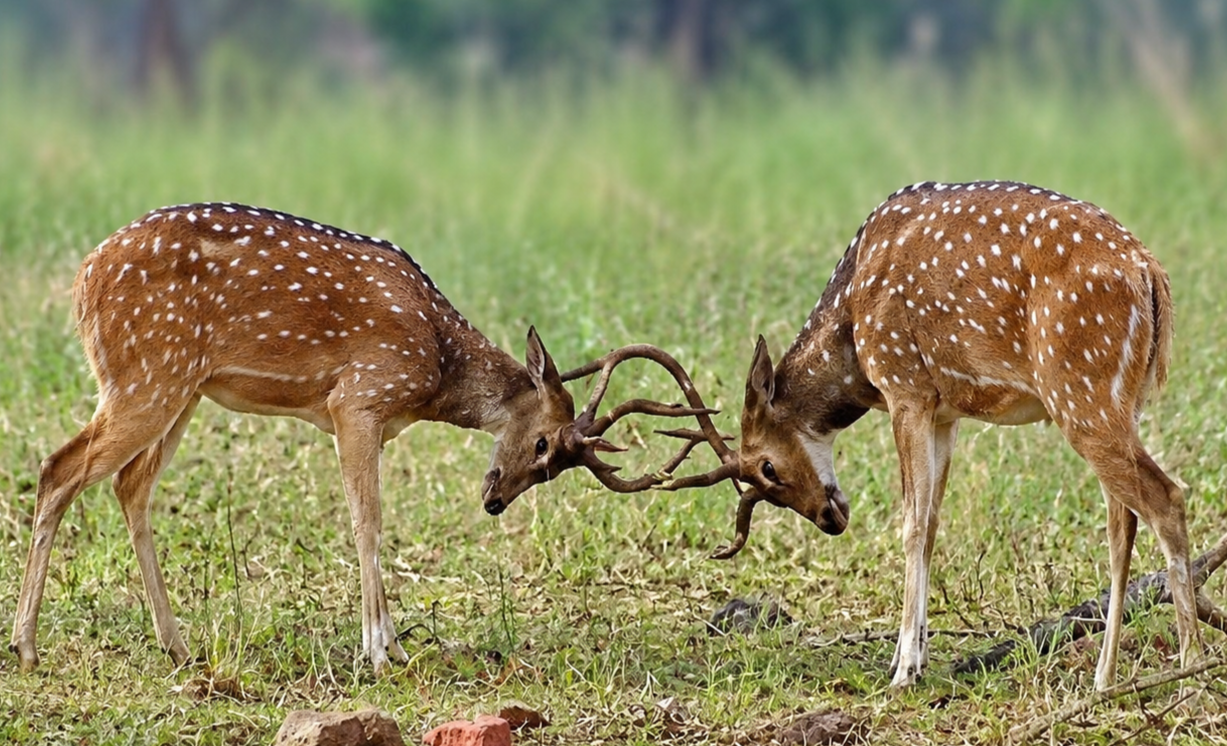
Chital are not territorial but may fight over the possession of females. This is a show of strength, rarely fatal with the loser backing off. However, marking behaviour is prominent amongst stags. Males have well developed preorbital glands near the eyes. They stand on their hind legs to reach the tall branches and rub the preorbital glands to deposit this scent. Urine marking is also observed.
The chital has a strong sense of smell and sniffs the air to detect predators, locate food and water and communicate with other deer. Stags often lift their heads and smell the air with curled upper lips to detect pheromones and receptive females.
The mature chital is about a meter tall and 1.5 meters in length. It has a reddish-brown coat with a while belly, inner-legs and under their short tail. The males are darker with black facial markings. Only males have antlers which could be almost a meter long. The antlers have three characteristic tines or branches. White spots are present on both the sexes and stay for life. A dark dorsal stripe runs the length of the animals back.
A chital mother often licks a fawns hind region. This is done primarily to stimulate bowel movements and urination while removing scents that could attract predators. Young fawns cannot easily defecate and urinate. It also helps in keeping the coat clean. Tasting secretions can help the mother detect pathogens and pass protective antibodies through milk. It also helps in strengthening the mother calf bond.
Chitals are polygynous. A stag may have a number of females in the harem. The gestation period is about 7.5 months. They usually have two fawns but one or three is not uncommon. It a fawn dies during the birth year, the mother can breed again to give birth to a second fawn.
@Srimaa Communication
Credits- Dr. Yashpal Singh, Mrs. Neena Singh, Mr. Rajesh Bedi and Mr. Manoj Kumar Yadav