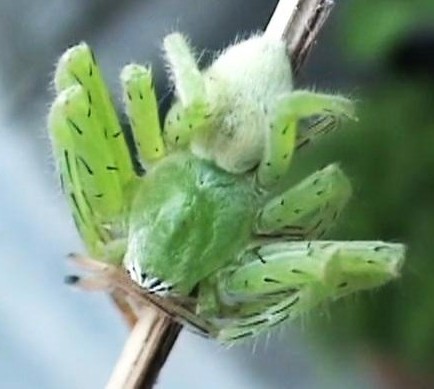

Green Huntsman Spider
This specimen observed in an urban garden at Gomti Nagar, Lucknow, Uttar Pradesh India is a female huntsman spider likely Gnathopalystes sp. / Olios milleti / Micrommatta virescens most likely Micrommatta virescens.
World wide there are 1380 species of huntsman spiders split between 98 genera.
Green huntsman spiders are diurnal do not build the traditional web and hunt in green vegetation. They can, however produce silk and use it for other purposes including creating draglines, egg sacs (Egg sacs on leaves are protected by females) and in the ‘spiderling’ phase for ballooning or travelling in the breeze. They may also use silk to bind leaves together to serve as a sheltered day time retreat.
Usually lives 1-2 years in the wild. Females often survive longer due to lower predation risks. They may be predated upon by birds, lizards, predator insects and large spiders.
Species has a Palearctic distribution and is found throughout Europe, parts of Asia and East Africa and in temperate regions with abundant vegetation. In India they are found generally in South India (Kerala/Andhra/Karnataka)
Bites from huntsman spiders are usually mild and may not need any hospitalisation. Venomous to prey but not considered dangerous to humans.
They exhibit sexual dimorphism. Adult females are very vivid green in colour with a slightly paler green abdomen. The adult males are smaller, green in colour. The abdomen of the adult male is reddish brown in colour with two longitudinal yellow stripes. They have eight small black eyes arranged in an oval ring and each surrounded by a ring of short white hair.
A few days after mating, the males die and the females may enclose the egg sac into a few leaves stitched together. Cocoons are generated by the females. After about four weeks eggs hatch about 40-50 spiders. Growth is slow taking almost 18 months to reach maturity.
Spiders may have missing limbs but sub adults are generally capable of regenerating the missing limbs during successive moulting.
©Srimaa Communication
Credits- Dr. Yashpal Singh, Mrs. Neena Singh, Mr. Manoj Kumar Yadav