
Musth, Oestrus and Reproductive behaviour in Elephants
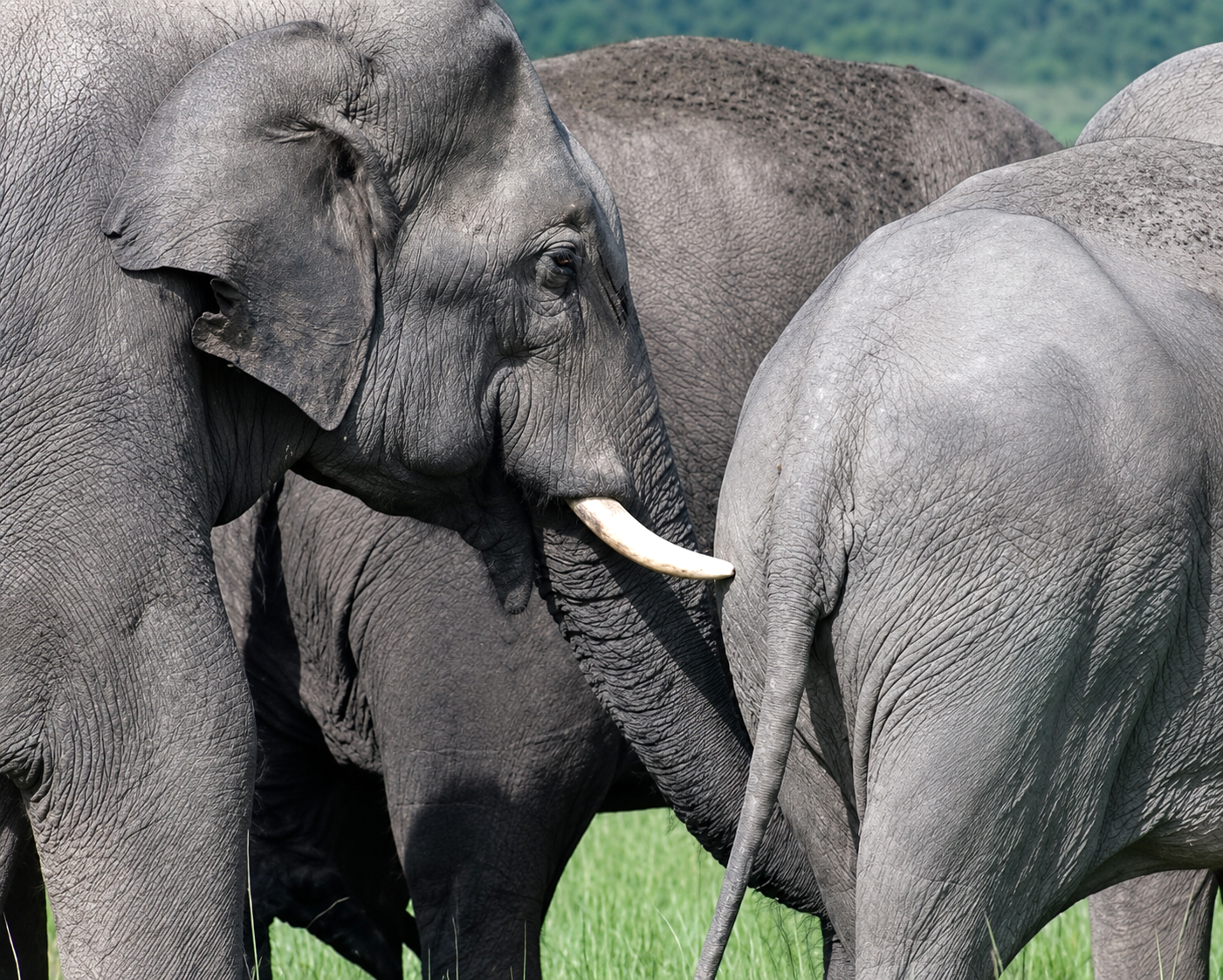
Elephants are social animals living in well-coordinated matriarchal groups with calves closely huddled with mother and aunts for safety. Family units may range from 10 to 20 animals and consist of the Matriarch, her adult daughters and their suckling calves along with juvenile and adolescent males. Often two or more closely related family groups may congregate together.
Adult bulls are solitary but may associate temporarily with herds having oestrous females. There are no long-term associations with any particular herd. Young bulls leave the family after twelve to fifteen years of their birth and may form all male groups or join other family units on a temporary basis, sometimes as less as a few hours. Most bulls spend almost 80% of their time away from their families. Young bulls are not tolerated within the families and are generally pushed away at some point of time. Cows remain in the family of their birth but bulls depart seeking newer social relationships with other bulls.
Most cow calf groups do contain at least one bull. In a group of 10 elephants or more about 10 to 15% will be males. The bulls associate at random moving between groups to search for oestrous females. The number of bulls and the individuals in the group may vary from day to day or even hour to hour. Moving away from the herd allows a bull to find a higher number of oestrous females and father more off springs in a year than when associated with group of limited oestrous females. Herd elephants are reported to father about 5 offsprings in a year whereas roving bulls’ father at least 30 offsprings in a year.
When bulls are with Cow calf groups they assess the reproductive status of adult cows. If there are no oestrous cows the bulls are likely to walk on and change the group.
Most larger bulls are not always reproductively active throughout the year but have specific active or musth periods.
Musth is a reproductive state in the life of bull elephants which determines their mating success. It is a period in which the mature bull elephant exhibits a copious secretion from the temporal gland on the sides of the head. In Asian Elephants, only bulls may show such discharges while in the African species, both males and females may exhibit such discharges during periods of stress or excitement. The Musth period is a period of behavioural, physical and physiological changes in the bulls. It is at this time that the bulls become highly irritable and aggressive towards each other and humans and actively seek oestrous females to copulate. While captive Asian and African Elephants can exhibit musth between 11 to 14 years of age, bulls are unlikely to come into musth before they reach 25 years of age. Interestingly while some younger bulls may be capable of coming into musth yet when they live in contact with older bulls, the musth is delayed because of reproductive suppression. Musth is associated with increases in the levels of sex hormones, Testosterone and androstenedione which increases sperm production and the capacity to copulate for reproductive success.
Each bull elephant may come into musth about once a year with the period of musth extending from some days to months. There is no seasonal pattern but often the period of musth and the date of onset is the same for each bull every year. Bulls also have the capacity to change their musth periods depending upon other males in musth and the availability of oestrous females. Younger bulls have shorter musth durations of one to ten days but older bulls may remain in musth for periods up to 120 days or even longer.
Musth, in younger elephants is stimulated by the presence of oestrous females. The musth period is shorter when lesser oestrous females are available. They may even skip the year entirely. A larger number of elephants come into musth during the peak breeding months of females. For a male it is essential to have receptive females around, at the same time as it is in musth. While smaller males remain subservient to large males during non musth periods yet a bigger bull, not in musth, would avoid a smaller bull in musth during courtship and mating. Older elephants not in musth may also occasionally mate. Females prefer Musth bulls and will cooperate with them in mating but avoid and run away from non musth bulls. During musth, the appetite of the bulls decreases and they spend more time in searching and fighting for females rather than food.
The Musth period enhances the males capacity to compete with other males in their search for females and also makes a bull more attractive to the females for better reproductive success.
During the period of musth, the bull loses its weight and exhausts its body reserves after which, being unable to cope up with ‘Musth’, it again goes back to active feeding.
Unlike other Mammals, the female genital opening is not present under the tail but the long back ward pointing vagina emerges via the vulva between her hind legs almost similar in position to an elephants penis.
The testes of males are permanently located within the body. In a fully grown male, the penis could be almost 1 meter long and controlled by voluntary muscles helping it to manoeuvre entry into the vagina.
Females mate during periods of ovulation. On meeting a female, a bull will test her urine or vulva by using his trunk and carrying scents to a specialised Jacobsons organ on the roof of his month. If she is in oestrous it will respond with excitement and remain with the cow testing her urine and vulva frequently. Courtship displays often lead to an oestrous chase where the bull chases the cow and lays his trunk over the head or back. The cow then either cooperates or runs away.
If the bull is successful in mounting, he will manoeuvre his penis into the down ward pointing vulva for ejaculation to take place. Almost one litre of ejaculate increases the chances of fertilization. The bull may stay together for some time guarding her from other males and occasionally copulating but leaves her when she is no longer likely to conceive.
©Srimaa Communication
Credits- Dr. Yashpal Singh, Mrs. Neena Singh, Mr. Rajesh Bedi, Manoj Kumar Yadav