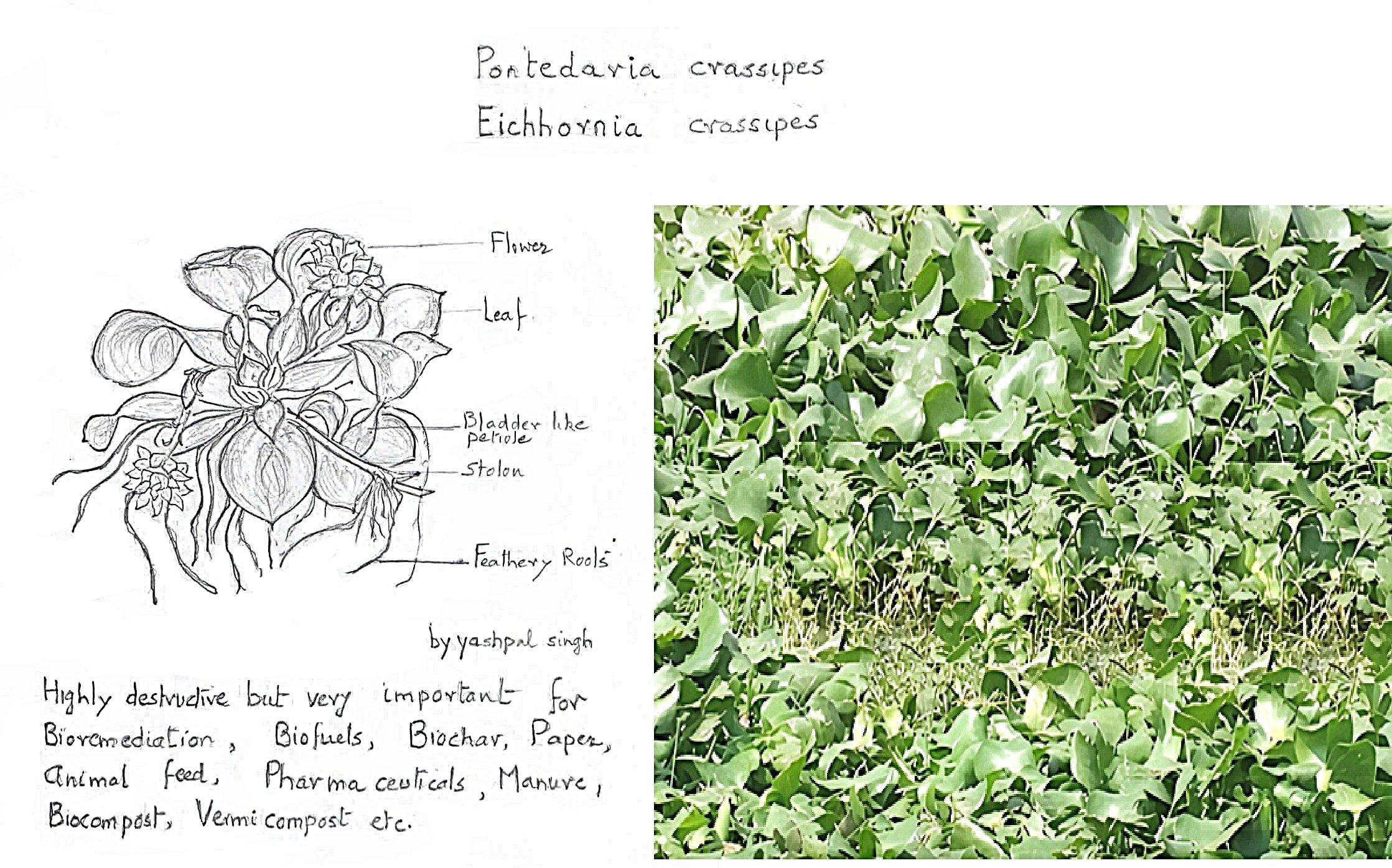

Eichhornia crassipes now Pontederia crassipes. Harmful and Beneficial aspects
By Dr. Yashpal Singh, Chairman, The Wealthy Waste School India
Native to the Amazon basin in South America, the Water Hyacinth, Eichhornia crassipes currently known as Pontederia crassipes, has now invaded many countries. The growth is governed by the availability of nutrients and temperature. Water Hyacinth draws all its nutrients directly from water and absorbs heavy metals, organic contaminants and nutrients from the water column. This property enables it to be used in waste water treatment and bio remediation also. The plant grows very fast, doubling in mass every 05 days under favourable conditions. Salinity concerns limit the growth of this species in coastal area but there are reports that it can survive both in fresh water and sea water. The seeds may be remained viable for almost 20 years. It is the most notorious floating water weed in most of the frost free tropical and sub-tropical areas of the globe.
Eichhornia grows in mats upto 02 metres thick which can reduce light and oxygen, change the water chemistry affect flora and fauna and cause intensive loss to water because of extensive evapo-transpiration. Unal, Aynur. (2020).
DeGaga, A.H. 2018 has studied the biology, ecology and economics of Eichhornia crassipes.
By blocking light and nutrients and also reducing the dissolved oxygen concentrations, the plants adversely affect the growth of plankton and other aquatic biota in areas beneath the root zone and impact the diversity, distribution and abundance of the various biotic components. This also encourages the proliferation of mosquitos and other pathogens connected with human health including malaria, schistosomiasis, encephalitis, filariasis, cholera, polio etc. Increased evapotranspiration may cause water stress. The death and decay of water hyacinth may also cause anaerobic conditions and the production of lethal anaerobic gases.
However, it may also provide temporary shelter for small aquatic organisms such as fishes etc. (Wang, Z. and Yan, S.H. 2017).
Removal of Eichhornia has been suggested as a management option. Manual and mechanical removal is beneficial but the removal rate should be greater than the rate of regrowth. Allowing the plant to die and decompose within a system has negative consequences. Prevention from entering a system appears to be the best approach. Biological control is effective but may take a long time. Some insects have been identified which serve as a biological control but the ecology needs to be examined.
Eichhornia is a good indicator of eutrophic waste waters enriched with Phosphorous and Nitrogen.
The IUCN has listed it among the top 100 aggressive invasive species and one of the 10 most destructive weed species globally. (Ben. B. et al. 2025).
Despite its negative impacts on ecology, Eichhornia has a number of beneficial uses which could be used for the benefit of mankind. Ropes and yarns, baskets, hats, mats, furniture, Fibre and paper can be gainfully made from the plant. E. crassipes is a renewable and sustainable bio mass resource. It Serves as a rich source of compost, can be used to generate Biogas, Bio ethanol and bio-briquettes and can be used as an animal feed. It also serves an important role in bio remediation.
As Animal Feed
Water Hyacinth contains 95% water and 5% dry matter of which 50% is silica, 30% potassium, 15% Nitrogen and 5% protein. Too much silica, calcium oxalate and potassium and too little protein may not make it suitable as animal feedstock. (Degaga 2018)
It can however, serve as livestock feed after proper treatment to reduce the water content and nutrient imbalance (Aftab Alam et.al. 2017). Water Hyacinth can also be used as a raw material in formulating fish feed. The leaf has been established to serve as a very good source of alternative fish feed (Mahmood, S. et al.2018). Improved growth performance and survival of fish was observed in diets supplemental with E. crassipes (Sipauba-Tavares, L.H. et al.2019).
The protein content has a high digestibility. Good results in terms of pH, odour and palatability of feed have been reported when wilted water hyacinth was supplemented with 5% molasses or 10% cassava. Production increases of 30% and reduced costs of 20% have been reported along with an increase in milk production in cattle by up to 20%. A lower feed cost/body weight gain has also been observed. The protein has a high digestibility (Akankali J. A., Elenwo E. I.2019).
Protein in the leaves of the plant contain most of the essential amino acids and is particularly rich in glutamine, asparagine and leucine (Poddar, K., et.al. 1991). Lignin, silica and cutin affect its digestibility. Water hyacinth grown in sewage has a high protein and mineral content. (McDonald, P.E.et.al, 1978).
Water Hyacinth can be fed fresh or wilted to animals. The high level of cellulose and hemi cellulose serve as a good source of energy for ruminants. (Thu, N.V. 2011). It has been gainfully utilised as feed when supplemented with rice straw. Wilted Water Hyacinth is generally preferred. It can also be successfully ensiled with molasses, rice bran, cassava root as well as with organic acids for acceptance by ruminants. (Chakraborty et.al., 1991). It has also been established as useful to rabbits, ducks and geese and fish singly or as a supplement to other feeds.
Since E. Crassipes is an accumulator of heavy metals, the food chain impacts may need to be examined.
As Biocompost and Manure
Water Hyacinth is 95.5% moisture, 0.04% N, 1.0% Ash, 0.06% P205, 0.20% K20, 3.5% organic matter. On a zero-moisture basis it is 75.8% organic matter, 1.5% N, 24.2% ash which contains 28.7% K2O, 1.8% Na2O, 12.8% CaO, 21.0% CI and 7.0% P2O5. (Matai, S. and Bagchi, D. 1980)
Aftab Alam etal.2017 have observed that Potash is important for determining the quality and taste of potato. Water Hyacinth used as bio manure was found to increase yield and quality of potato and reduce water pollution. They report that the use of Water Hyacinth both as manure and compost has improved the yield in other plants like rice, corn, sesame, brinjal, onion, gourd, tomato, maize.
The Harike wetland initiative in Punjab removes the Water Hyacinth from water bodies and converts it to organic compost (Rupal Dupare et.al. 2025)
Water Hyacinth either alone or in combination with cow dung has been observed to be a vermicomposting raw material. The solo use of water hyacinth was observed to give better vermicompost (Mora, H et al.2013). A 60 days vermicomposting cycle in conjunction with Lactobacillus sporogenes led to an increase in nutrient composition making it a good bio fertilizer (Saktikha, T. and Sornalakshmi, V. 2019).
Water Hyacinth has been used as mulch and compost and for paper making (Nolan and Kirinse, 1974) and biogas generation. It is a good source of organic carbon and is used as an organic fertiliser either alone or as a supplement. Phyto remediation followed by bio as and production of ethanol are other options.
A rich presence of Carbon, Nitrogen, Phosphorous and Potassium also makes E. crassipes a very important raw material for compost either alone or in conjunction with other materials such as cow dung and saw dust. It has also been suggested as a good option for controlling acidic soils and improving the soil chemistry. (John, M. 2016). Mixing with other wastes like animal wastes, plant wastes, house hold and domestic wastes etc and using on soil improves the water retention in soils and land locked areas. (Stephan B. and Selvaraju, R. 2012) I would suggest that some studies could be initiated on the use of Eichhornia crassipes with press mud and distillery spent wash for bio compost. The high nitrogen in Eichhornia may balance the high potash of spent wash.
The pyrolysis of Eichhornia crassipes in the absence of oxygen produces biochar which has good nutritive value and application to soil enhances crop productivity with improved soil health. ( Kumari, K.et al.2021)
Bio energy, Biogas and Ethanol
The high content of cellulose and hemicellulose allow it to be used as an important source for bio energy including bio gas and bio ethanol (Nahar, K. and Sunny, S.A. 2024) composting and other ecofriendly products.
The fast growth dynamics and biochemical composition make E. crassipes an important Ligno-cellulosic feed stock for biofuel. The theoretical yields obtained from the cellulosic and hemi cellulosic contents of Eichhornia crassipes following use in phytoremediation indicated an yield of 210.85 ml H2/g D.W.,150.28 ml/g DW of methane and 0.278 g/g D.W. bioethanol. (Sharma Kritika etal.2022)
- crassipes is a good raw material for the production of Bio-fuels. The low lignin content allows the hemicellulose and cellulose to be easily converted to fermentable sugar which can be exploited for the bio fuel industry. Potassium hydroxide extracts of E. crassipes have served as an important means of bio diesel production (Efeobokhan, V.E. 2013).
In India, the saccharification and fermentation of NaOH/H2O2 treated water hyacinth has been observed to be a promising strategy for ethanol fermentation (Gandhimathi, A. 2017). The maximum ethanol concentration from pretreated water hyacinth at 350C was almost twice as that produced by Saccharomyces cerevisiae at 30 0 C.
The high amount of hemicellulose helps in producing biogas from water hyacinth. About 3 liters of biogas was reported (Fadairo, A. A. and Fagbenle, R.O.2014) to be produced when 2.5 Kg of dried bio mass of water hyacinth was mixed with cow dung and poultry drippings in the ratio of 2:2:1. Methane and carbon dioxide were produced up to 62% and 34% respectively. Pretreatment of water hyacinth with pure cultures of Citrobacter werkmanii was reported to produce 3 times more bio gas than that from untreated water hyacinth. (Barua, V.B. et al. 2018). Chemical pretreatment of water hyacinth with 5% V/V concentration of H2SO4 and a residence time of 60 minutes produced almost 130% more ethanol than that from untreated water Hyacinth (Barua, V.B. et al. 2017).
Bio- Remediation
Opeyami A.et al. 2020 have presented a good account of the economic significance of E. crassipes.
Eichhornia helps in the bio remediation of waste water, absorbing heavy metals from toxic wastes and excessive nutrients from organically enriched eutrophic systems. ( Rupal Dupare et al. 2025). The roots of E. crassipes absorb toxic pollutants and chemicals in high concentrations (Mukesh D. and Anjani, K.D. 2018). Waste waters containing Heavy metals, dye stuffs and dissolved ions can be effectively treated with E. crassipes (Adewumi, I. and Ogbiye, A.S. 2009; Priya E.S. and Selvan, P.S. 2017). The leaves, roots and bulb tissues of the plant have hyper accumulative abilities for heavy metals. It has also been useful in the bio remediation of soils contaminated with crude oil and total Petroleum hydrocarbons (Udeh, U. et al. 2013) and is also used as a bioindicator of heavy metal pollution (Srivastava, A. et al. 2019). It is a good plant for the rhizofiltration process. Remediation with E. crassipes has been reported to considerably lower the Heavy metal content, carbon and the BOD of toxic waste waters. (Victor, K.K.et al.2016) Almost 99.5% of chromium recovery along with TDS and BOD was achieved when toxic waste waters from the Sukinda-chromite mines in Jaipur when E. crassipes was used with a 15 days phytoremediation exposure. (Saha, P. et al.2018). Almost 95% removal of cyanide was obtained in blast furnace effluents using E. Crassipes. (Saha, P. et al.2018). Nitrogen is efficiently absorbed from eutrophic waste waters and excess nitrogen stored in the root and shoot system of Eichhornia.
Water Hyacinth has been successfully used to remove pollutants like BOD, TSS, TDS, Nitrogen, Phosphorous and Heavy metals etc. from waters. (Gupta et. al. 2012). Roots act as a natural bio sorbent. (Low et.al. 1994) With a profuse growth the economic importance of roots may need to be examined.
Use in the making of Paper
With 95% water, fibrous tissue and a high energy and protein content E. crassipes has a number of uses. The yield of kraft paper from E. Crassipes is low, the residual lignin content is high, the obtained pulp darkens with time. Pulp has a high concentration of organic substances and fines creating problems in paper sheet production. The final bleaching is low (Unal, Aynur. 2020). However, water Hyacinth blended with up to 50% jute or waste paper can yield good quantity paper. (Opeyami Ayanda et al. 2020)
Some other innovative uses
Assam operates a program entitled “Weed to Wealth’ and Punjab has taken the Harike Wetland initiative for the beneficial use of water Hyacinth.
The dried plant may also be woven into products like mats, ropes and furniture. (Rakotoarisoa, T.F. et.al. 2016). This is adopted in the ‘Weed to Wealth’ initiative of the Assam State Rural Livelihood Mission which provides training. (Sarma, S.S. and Sanowal,S 2021). I feel that this could help in Carbon sequestration also. Fibers from the petioles have been used to make ropes, baskets, carpets etc. (Malik 2007).
The Harike Wetland Initiative of Punjab utilises Fiber from Water Hyacinth to create ecofriendly handicrafts which provide a source of income. Fiber could also be used for making ropes. The Housing and Building Research Institute in Dhaka has carried out work on the use of Water Hyacinth in the production of fibre. The Ajay Bahu-udeshiya Sanstha in Chandrapur Maharashtra is also making handicraft products out of Eichhornia stems. (Unal, Aynur. 2020). Marketing is a challenge which may need to be strengthened.
Pharmaceuticals
- crassipes has significant industrial and medicinal applications. Alkaloids, phenolic compounds, tri terpenoids, flavonoids, tannins and saponins found as secondary metabolites in E. crassipes have been observed to demonstrate promising pharmacological properties. Potassium, chlorine, calcium and aluminium were some nutritionally important chemicals present in large amounts in the plants. Gebrehiwot, H. et al. 2022 The plant parts have been extensively reported to possess anti-inflammatory, antioxidant, antifungal, anti-aging, anticancer, hepato-protective and anti-bacterial properties (Gayatri 2019; Lalitha, P. and Jayanti, P. 2014; Aboul-Enein, A.M. et al.2014; Kumar, S. et al. 2014). The insecticidal, allelopathic and larvicidal effects have also been investigated. It can also be used as a hair Fragrance and to treat diseases like Cholera, sore throat and snake bites. (Pandey, S. et al. 2015).
Bibliography
- Aboul-Enein A. M., Shanab S. M. M., Shalaby E. A., Zahran M. M., Lightfoot D. A., El-Shemy H. A. (2014) Cytotoxic and antioxidant properties of active principals isolated from water hyacinth against four cancer cells lines. BMC Complementary and Alternative Medicine. 2014;14 doi: 10.1186/1472-6882-14-397. [DOI] [PMC free article] [PubMed] [Google Scholar].
- Adewumi I., Ogbiye A. S. (2009) Using water hyacinth (Eichhornia crassipes) to treat wastewater of a residential institution. Toxicological & Environmental Chemistry. 2009;91(5):891–903. doi: 10.1080/02772240802614648. [DOI] [Google Scholar]
- Aftab Alam, Sunit Kr. Srivastava, Kumar Anand, Pritam Bala Sinha, Prashant Kr. Mishra (2017) Response of Water Hyacinth as a source of potassium in the production of Potato. International Journal of Innovative Research in Science, Engineering and Technology. IJIRSET. Vol. 6, Issue 7, July 2017. 15010 to 15014.
- Akankali J. A., Elenwo E. I. (2019) Use of water hyacinth as feed stuff for animals in Niger delta, Nigeria. International Journal of Advanced Scientific Research and Review. 2019;4:91–97. [Google Scholar].
- Ayana Bogale (2021). Economic Importance, Impacts and Possible Mitigation Measures of Aquatic Water hyacinth (Eichhornia crassipes Martins) in Elthiopia. Journal of Environment and Earth Science. ISSN 2224-3216. Vol.11, No. 3, 2021.
- Barua V. B., Goud V. V., Kalamdhad A. S. (2018) Microbial pretreatment of water hyacinth for enhanced hydrolysis followed by biogas production. Renewable Energy. 2018;126:21–29. doi: 10.1016/j.renene.2018.03.028. [DOI] [Google Scholar].
- Barua V. B., Raju V. W., Lippold S., Kalamdhad A. S. Electrohydrolysis pretreatment of water hyacinth for enhanced hydrolysis.(2017) Bioresource Technology. 2017;238:733–737. doi: 10.1016/j.biortech.2017.04.016. [DOI] [PubMed] [Google Scholar]
- Ben B, W., Ezzariai, A., Karouach, F., Sobeh, M., Kibret, M., Hafidi, M., & Yasri, A. (2025). Eichhornia crassipes (Mart.). A comprehensive review of its chemical composition, traditional use, and value-added products. GreenariA 03(03): 06 – 11 Frontiers in pharmacology, 13, 842511.
- Degaga A.H. (2018). Water Hyacinth (Eichhornia crassipes) Biology and its impacts on Ecosystem, Biodiversity, Economy and Human wellbeing. J. life Sci. Biomed. 8(6:94-100) www.jisb.sceinceline.com.
- Efeovbokhan V. E. (2013) Ota, Nigeria: Department of Chemical Engineering, Covenant University; 2013. Investigating bio-diesel production using potash from agricultural wastes. Ph.D. thesis. [Google Scholar].
- Fadairo A. A., Fagbenle R. O. (2014) Biogas production from water hyacinth blends. Proceedings of the 10th International Conference on Heat Transfer, Fluid Mechanics and Thermodynamics; July 2014; Orlando, FL, USA. [Google Scholar].
- Gandhimathi A. (2017) Enhanced biofuel production from water hyacinth. Ecology. Environment and Conservation Paper. 2017;23(3):1586–1590. [Google Scholar].
- Gayatri (2019) 11 amazing benefits of hyacinth herb for skin, hair and health. 2019. https://www.stylecraze.com/articles/benefits-of-hyacinth-herb-for-skin-hair-and-health/#gref.
- Gebrehiwot, H., Dekebo, A. and Endale, Milkiyas (2022). Chemical composition, Pharma cological activities and biofuel production of Eichhornia crassipes (Water Hyacinth): A review. Journal of the Turkish Chemical Society. JOTCSA. 2022:9(3):849-866.
- Khotsa, M.D., Mkolo, N.M., Motshudi, M.C., Mphephu, M.M., Makhafola, M.A., Naidoo, C.M. (2025). A comprehensive review of the biology, Ecological impacts and control strategies of Eichhornia crassipes. Diversity 2025, 17, 564. https://doi.org/10.3390/d17080564.
- Kumar S., Kumar R., Dwivedi A., Pandey A. K. (2014) In vitro antioxidant, antibacterial, and cytotoxic activity and in vivo effect of Syngonium podophyllum and Eichhornia crassipes leaf extracts on isoniazid induced oxidative stress and hepatic markers. BioMed Research International. 2014;2014:11. doi: 10.1155/2014/459452.459452 [DOI] [PMC free article] [PubMed] [Google Scholar]
- Kumar, M., Arya, A. and Makwana, N. (2020). Production of Paper Pulp by Water Hyacinth (Eichhornia crassipes) in Rajasthan State in India. International Journal of Engineering Research, Vol. 9. Special Issue no. 2. (Pages 98 to 103).
- Kumari, K., Swain, A.A., Kumar, M. et al.( 2021) Utilization of Eichhornia crassipes biomass for production of biochar and its feasibility in agroecosystems: a review. Environmental Sustainability 4, 285–297 (2021). https://doi.org/10.1007/s42398-021-00185-7.
- Lalitha P. and Jayanthi P. (2014) Antiaging activity of the skin cream containing ethyl acetate extract of Eichhornia crassipes (Mart.) solms. International Journal of Pharm. Tech Research. 2014;6:29–34. [Google Scholar].
- Low, K.S., Lee, C.K. and Tai, C.H., (1994). Biosorption of copper by water hyacinth roots. Journal of Environmental Science & Health Part A, 29(1) :171-188.
- Mahmood S., Khan N., Iqbal K. J., Ashraf M., Khalique A. (2018) Evaluation of water hyacinth (Eichhornia crassipes) supplemented diets on the growth, digestibility and histology of grass carp (Ctenopharyngodon idella) fingerlings. Journal of Applied Animal Research. 2018;46(1):24–28. doi: 10.1080/09712119.2016.1256291. [DOI] [Google Scholar].
- Matai S, Bagchi D. (1980) Water hyacinth: a plant with prolific bioproductivity and photosynthesis.
- McDonald, P.E., RA, G., JFD, M. and CA, S., LA and Wilkinson RG (2011). Animal nutrition. Seventh Edition, Pearson Education Limited, Edinburgh Gate, Harlow, Essex CM20 2JE, England. pp.692.
- Mora H., Deka S., Baruah C. K. (2013) Vermicomposting of water hyacinth eichhornia crassipes (mart. solms) employing indigenous earthworm species. Proceedings of the International Conference on Chemical, Agricultural and Medical Sciences (CAMS-2013); 2013; Kuala Lumpur, Malaysia. [Google Scholar].
- Mukesh D., Anjani K. D. (2018) Valuable product from water hyacinth–review paper. International Research Journal of Engineering and Technology. 2018;5(3):838–842. [Google Scholar].
- Nahar, K., & Sunny, S. A. (2024). Co benefits of Eichhornia Crassipes (water hyacinth) as sustainable biomass for biofuel production and aquatic ecosystem phytoremediation. Fuels, 5(3), 317-333.
- Opeyami I Ayanda, Tolulope Ajayi and Asuwaju, Femi P. (2020). Scientific World Journal. July 7; 2020/3452172.
- Pandey S., Singh N., Nirala A. K., Giri A. (2019) Dynamics of water weed eichhornia crassipes: a review. International Journal for Research in Applied Science & Engineering Technology. 2015;3:137–140. [Google Scholar].
- Pintor_Ibarra et.al. (2020). Kraft Pulping and Bleaching of Eiccharnia crassipes (Mart.) Solins. (Water Hyacinth) Bioresources 15 (4), 9243-9264.
- Poddar, K., Mandal, L. and Banerjee, G.C., (1991). Studies on water hyacinth(Eichhornia crassipes)- chemical composition of the plant and water from different habitats. Indian Veterinary Journal, 68(9) :833-837.
- Priya E. S., Selvan P. S. (2017) Water hyacinth (Eichhornia crassipes)–an efficient and economic adsorbent for textile effluent treatment–a review. Arabian Journal of Chemistry. 2017;10:S3548–S3558. [Google Scholar].
- Rakotoarisoa, T. F., Richter, T., Rakotondramanana, H., & Mantilla Contreras, J. (2016). Turning a problem into profit: Using Water Hyacinth (Eichhornia crassipes) for making handicrafts at Lake Alaotra, Madagascar. Economic Botany, 70, 365-379.
- Rupal Dupare, Parmeet Kaur, Jay Mule and Shilpakar Narwade (2025). Greenaria. Vol 03, Issue 03, ISSN:2584-153X. Article I.D. G-25-0303.
- Saha P., Mondal A., Sarkar S. (2018) Phytoremediation of cyanide containing steel industrial wastewater by Eichhornia crassipes. International Journal of Phytoremediation. 2018;20(12):1205–1214. doi: 10.1080/15226514.2017.1375898. [DOI] [PubMed] [Google Scholar].
- Saha P., Shinde O., Sarkar S. (2017) Phytoremediation of industrial mines wastewater using water hyacinth. International Journal of Phytoremediation. 2017;19(1):87–96. doi: 10.1080/15226514.2016.1216078. [DOI] [PMC free article] [PubMed] [Google Scholar].
- Sakthika T., Sornalaksmi V. (2019) Nutrients analysis of vermicompost of water hyacinth supplemented with probiotics. Acta Scientific Agriculture. 2019;3(10):10–13.doi:10.31080/asag.2019.03.0637. [DOI] [Google Scholar].
- Sarma, H.H., & Sanowal, S. (2024). Green Gold: Water Hyacinth as a Gateway to Agri-preneurship in Assam. Indian Farmer, 11(7), 236-243.
- Sharma Kritika, Kumar Ajay, Sharma Ruchi and Singh, Neetu (2022). Indian Journal of biochemistry and biophysics (IJBB) Vol. 59(3).
- Sipaúba-Tavares L. H., Silva J. D. S. A., Fernandes J. B. K.( 2019) Eichhornia crassipes biomass as a dietary supplement for Pterophyllum scalare (Schultze, 1823) Acta Scientiarum. Animal Sciences. 2019;41 doi: 10.4025/actascianimsci.v41i1.43690.e43690 [DOI] [Google Scholar].
- Srivastava A., Chahar V., Sharma V., et al. (2019) Study of toxic elements in river water and wetland using water hyacinth (Eichhornia crassipes) as pollution monitor. Global Challenge. 2019;3(6) doi: 10.1002/gch2.201800087.1800087 [DOI] [PMC free article] [PubMed] [Google Scholar].
- Stephan B., Selvaraju R. (2012) Farm Yard Manure and Water Hyacinth Compost Applications to Enhance Organic Matter and Water Holding Capacity of Soils in Drought Prone Areas of Bangladesh. Rome, Italy: Natural Resources Management and Environment Department, TECA, FOA; 2012. [Google Scholar].
- Thu, N.V., (2011). Effects of water hyacinth (Eichhornia crassipes) in local cattle diets on nutrient utilization, rumen parameters and microbial protein synthesis. In SAADC 2011 strategies and challenges for sustainable animal agriculture-crop systems, Volume III: full papers. Proceedings of the 3rd International Conference on sustainable animal agriculture for developing countries, Nakhon Ratchasima, Thailand, 26-29 July, 2011.pp. 422-426. Suranaree University of Technology.
- Udeh U., Nwaogazie I. L., Momoh Y. (2013) Bioremediation of a crude oil contaminated soil using water hyacinth (Eichhornia crassipes) Advances in Applied Science Research. 2013;4:362–369. [Google Scholar].
- Unal, Aynur. (2020). Making Paper from. https://www.researchgate.net/publication/344239551_Making_Paper_from.
- Victor K. K., Séka Y., Norbert K. K., Sanogo T. A., Celestin A. B. (2016) Phytoremediation of wastewater toxicity using water hyacinth (Eichhornia crassipes) and water lettuce (Pistia stratiotes) International Journal of Phytoremediation. 2016;18(10):949–955. doi: 10.1080/15226514.2016.1183567. [DOI] [PubMed] [Google Scholar].
- Wang, Z., & Yan, S. H. (2017). Direct and strong influence of water hyacinth on aquatic communities in natural waters. In Water Hyacinth (pp. 44-65). CRC Press.