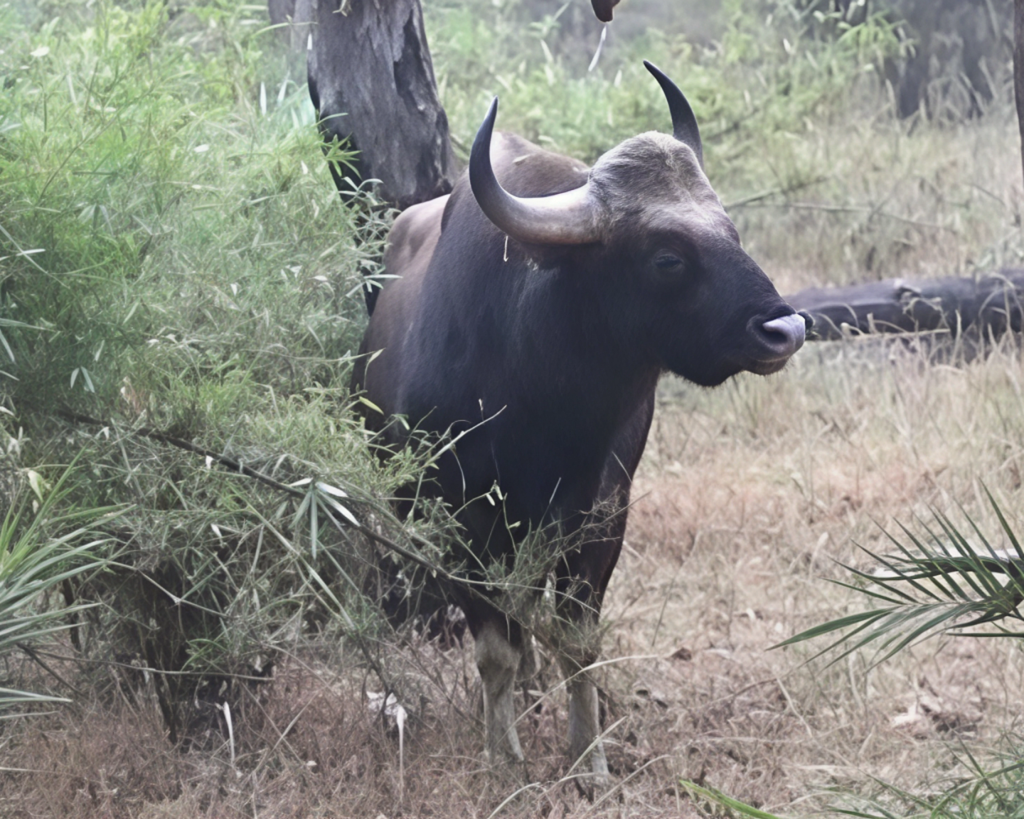

The Gaur Bison (Bos gaurus)
The family Bovidae including all domestic or wild oxen, sheep and goats, antelopes and gazelles is the largest family of the division Artiodactyla or even toed ungulates.
Indias wild oxen include the Gaur Bison (or the Indian Bison); the banteng or Tsaine (Malayan animal occurring within Indian limits in the frontier areas) and the ‘Yak’ and the Buffalo.
The Gaur bison with a population size of 13 to 30 thousand can live up to 26 years. It is a Bovine, native to south and south east Aisa found in Bhutan, Cambodia, China, India, Laos, Malaysia, Myanmar, Nepal, Thailand, Vietnam and Bangladesh and is the largest species amongst wild cattle. It generally inhabits Tropical Dry Forest and Tropical moist forests. They do not migrate. This specimen is from the Bandhavgarh National Park, Madhya Pradesh, India observed in January 2026. The Gaur is a tropical animal and is considered to be at the top of the food chain because it can be preyed only by the largest carnivores. In forests in India, only the tiger can deal with the Bison or the wild buffalo.
The gaur has a huge head a massive body and sturdy limbs. It is the embodiment of vigour and strength. A prominent characteristic is the muscular ridge on the shoulders which slopes towards the centre of the back and ends with an abrupt dip. Young bulls and cows are coffee to reddish to brown. Old bulls are jet black with almost hairless bodies, an ashy fore head with while stockinged feet. The Gaur bison may attain a height of 165-220 cm and length 250-330 cm. It is a member of the big five in India which include the tiger, elephant, leopard and rhinoceros. Females are slightly shorter. A Gaur bison may weigh about 1000 kg. They are the largest living bovids. Despite their heavy build, wild oxen are very active and light footed. The ‘Yak’ and Bison or the ‘Gaur’ are great climbers and may access the steepest of slopes with speed and agility and may run at speeds up to 35 mph.
The limbs of all hoofed animals are designed primarily to carry and move the heavy bodies. All hoofed animals walk on the tips of their toes. Hoofed animals possess a reduced number of toes which helps them to reduce the resistance to movement. The reduction in the number of toes has progressed on different evolutionary lines, the plan being to lengthen and strengthen the bones of one or more toes and to dispense completely with others. In oxen, the third and fourth toes are greatly developed and equal in size. The two hooves that encase these toes appear like a single hoof cleft in two. The Gaur Bison has small and closely knitted hooves to help it in its rugged, hard stony habitat. The wild buffalo on the other hand has wide-splayed hooves well suited to movement in mainly marshy soil.
The horns consist of two parts. A core of bone arising from the skull and an outer sheath or cap which is hollow and can be renewed whole from its bony cover. Deer on the other hand have solid horns which are shed. Horns in the Bovidae persist throughout life. The horns of oxen are present in both sexes and are nearly of equal length.
Bisons ordinarily live in small herds of 8 to 12 animals Gaurs live in herds, usually led by a dominant female, several families often uniting into large assemblages and except during the mating season, bulls of all sizes live together with cows. When mature the bulls may venture out in search of food and females in heat and on locating a suitable herd, join the herds and protect the females from competing males until they have mated. No territory is established. Old bulls past the age or capacity to mate lead permanently solitary lives. They have a very greatly developed sense of smell and the body odours tend to keep the herds together.
The Food primarily comprises of grass and cellulose rich foliage and has to be to be eaten quickly in order to avoid exposure to predators while feeding in open grazing lands. They are equipped to swallow large quantities of food during comparatively short periods of feeding and chew and assimilate later when resting in safety and seclusion.
The Gaur bison exhibits dominance hierarchy established more by threat displays rather than actual fights and is largely based on size and age. The high-ranking males have the first call on females in season. Gaur bison are non-territorial and may share their ranges with other members of their species. They may fear and avoid man.
The Gaur bison has a polygynous mating system where one male mates with a number of females. Females generally have an interval of 12 to 15 months between births and the gestation period is usually 220 to 280 days after which a single calf may be born. It is weaned at the age of about 9 months and becomes reproductively mature when it is 2 to 3 years old.
When about to calve the cow gaur moves away from the herd and drops the calf in some secluded spot. The mother stays in the vicinity of the calf for a few days but may desert it and rejoin the herd if disturbed. Instances have been recorded when a calf could walk just 10 minutes after its birth or gallop 30 minutes later.
While some wild oxen have been domesticated, all efforts to domesticate the Gaur have failed but they have been observed to breed with domestic cattle specially in Assam (The Hybrid cattle is generally called ‘Mithan) Subsequent breeding of ‘Mithan’ with domestic cattle diminishes the ‘Gaur’ like characters of the offsprings and frequent inter breeding with wild gaur is essential.
Vulnerable as per IUCN Red List. Population density is 15000 to 35000 individuals globally.
©Srimaa Communication
Credits- Dr. Yashpal Singh, Mrs. Neena Singh, Mr. Manoj Kumar Yadav