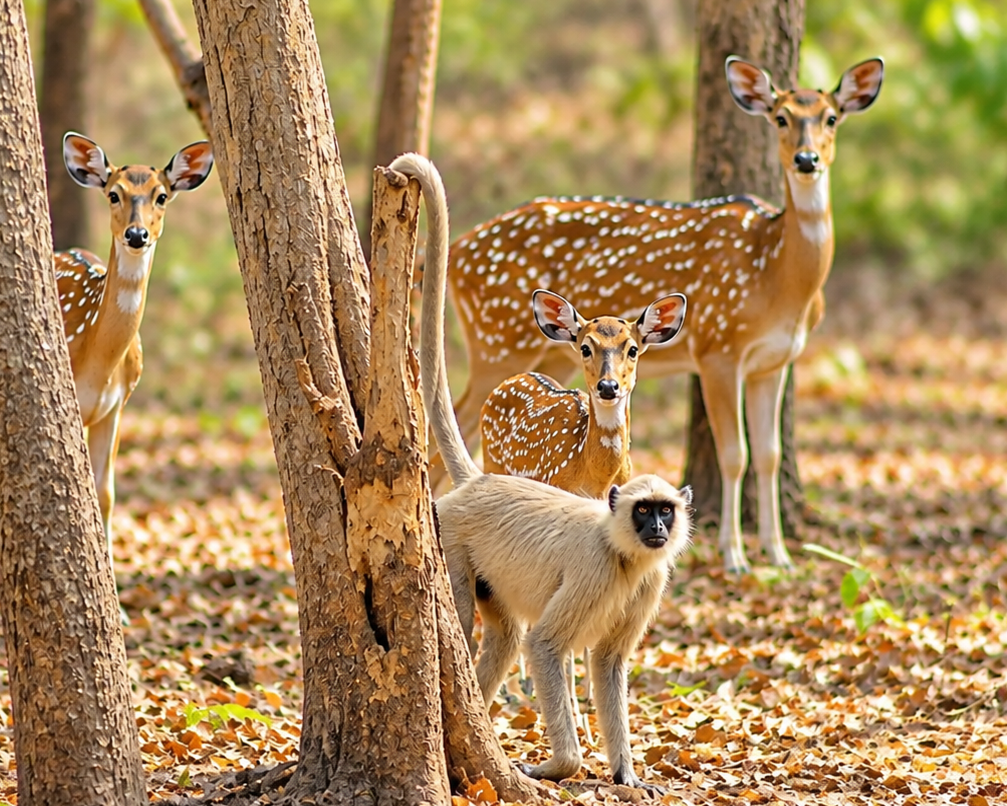

Sympatry in Primates and Ungulates
Primates and Ungulates demonstrate mutualism which is a very close ecological relationship in the forest. This association demonstrated best by the Hanuman Langur (Presbytis entellus) and the Cheetal (Axis axis) and occasionally the Sambhar in the forests of India helps the Langur and the Deer to mutually benefit each other. The Langurs provide a look out service for predators from the tops of the trees while the deer utilize their fine senses of smell and hearing from the ground to alert against predators. Both have typical alarm calls which helps others animals to stay vigilant for predators. Sympatry refers to the presence of two or more species in a common geographic area where the distribution of either species overlaps partially or completely. This is true for the primate and ungulate populations in the forests of India.
Primate ungulate sympatry has been well documented. Most work has been done on langurs and cheetal.
A primate-ungulate relationship is not a recent phenomenon but is the product of a long existing sympatry between both groups in open predator rich environments dominated by herbivores.
Both the deer and the langur share the same habitat resources and the same predators. Habitat overlapping between these two are very frequent. The relationship is favourable for the ungulates through predator avoidance and increased foraging success.
The resources dropped by the langurs from the forest canopies are consumed by the deer. Deer have been observed to show dependence on langurs for foliage, fruits, flowers and buds. This is specially in the drier seasons when the deer change from grazers to browsers because of lack of grass.
The Langur-Deer and the macaque deer associations are well reported from Asia. Through gleaning on food items dropped by the primates feeding in trees, ungulates frequently exploit fruits, leaves, flowers and seeds gaining access to other wise unavailable resources. The interactions have been interpreted as cases of commensalism or asymmetrical mutualism benefiting only the ungulate population for food. Sounds produced by the primates may often help ungulates to locate areas where they could glean and follow primates from tree to tree.
While sambhar deer are quite frequent during the day time often in small isolated numbers, they are more active during the night and favor dense cover during the day. Langurs are active during the day and therefore this relationship with Sambhar appears to be more situational rather than a constant companionship.
While Cheetal ordinarily follow langur troops to eat leaves, buds and fruits dropped from the canopy daily, swamp deer are dedicated grazers and rarely trail langurs strictly for food. Their ecological bond is centered on shared vigilance.
Foraging associations are linked to food availability and may help in mitigating limited resource availability. The cheetal deer may use cues from the langur such as movement in the tree canopy and leaves dropping to initiate this association which could be a form of commensalism, benefitting only the Cheetal which may follow the langur from tree to tree.
Because langurs eat from the upper canopy while swamp deer primarily graze on grasses and low shrubs, the two species occupy different ecological niches. They can travel and feed near each another without competing for exactly the same food supply.
In Indian tropical forest ecosystems, the interrelationship between Swamp deer and gray langurs is primarily an indirect, mutualistic predator warning network rather than a close foraging partnership seen between langurs and spotted deer.
Langurs give sharp coughing or loud alarm calls when spotting big cats below and the cheetal emits a high frequency resonant bark when they detect danger. Primates alert the ungulate population more than the ungulates alert the primates through their calls.
Ungulates have been reported to be less vigilant in the presence of primates. Primates may often mix with ungulates, mount and groom ungulates as part of this mutualism.
Interspecific grooming and playing together is also an important trait for asymmetrical mutualization,
Interspecific social behaviors have also been observed. Occasionally monkeys have been observed piggy back deer and groom them or rest in close contact or even play.
@Srimaa Communication
Credits- Dr. Yashpal Singh, Mrs. Neena Singh, Mr. Rajesh Bedi and Mr. Manoj Kumar Yadav