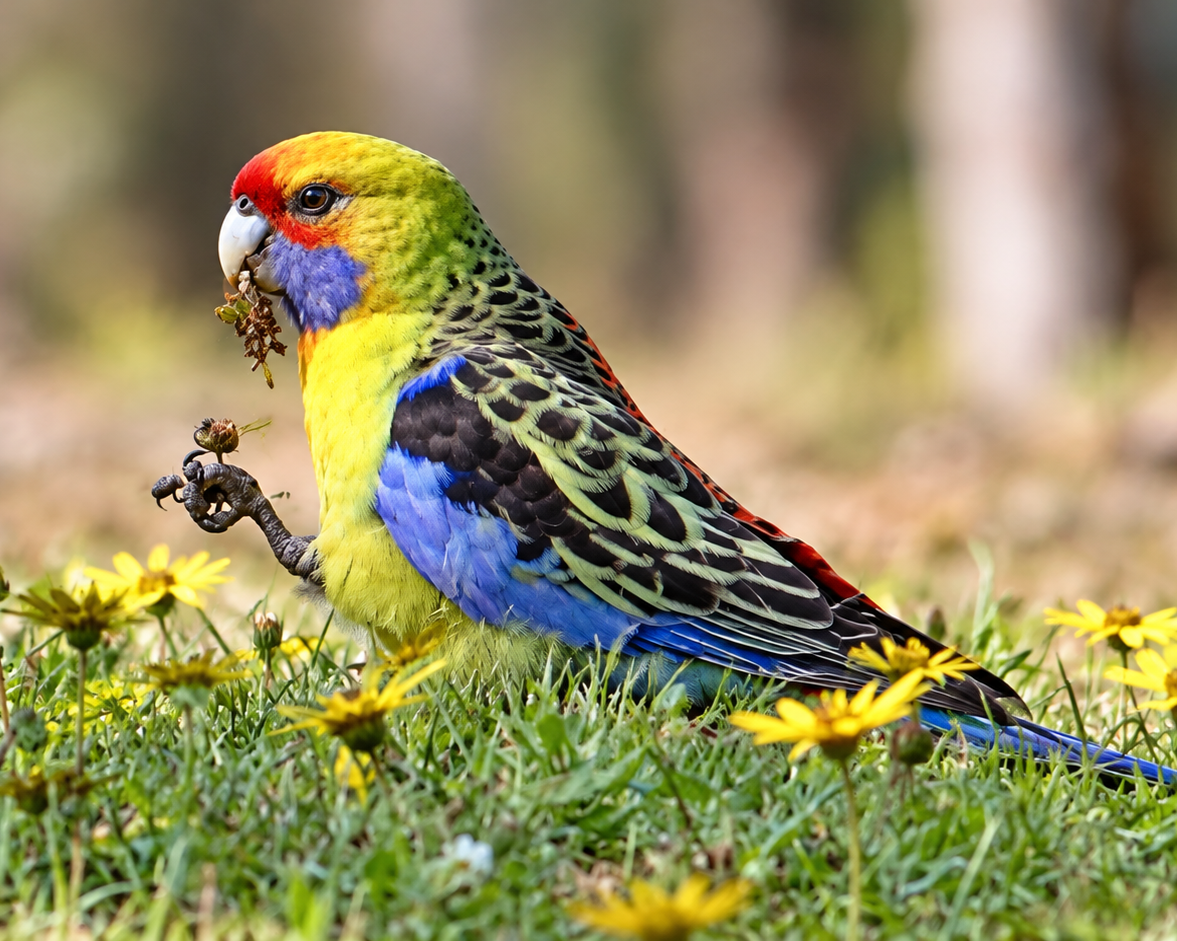

Reporting a hitherto unreported Green Rosella, endemic to Tasmania, from the Australian mainland demonstrating its special prehensile footed feeding mechanism
At the Albury War Memorial, Monument Hill, Albury, Australia, in September, 2026, our attention was drawn to this lone bird feeding on the ground in the surrounding wild woods. What really interested us was the way it was using its feet to bring food close to its mouth, using them as hands. We could guess that it is a Rosella, which is a genus composed of 06 species within the true Parrot family, the Psittacidae.
Rosellas, we understood are native strictly to Australia and nearby islands, with some introduced populations in New Zealand. Parrots, however, are distributed globally with almost 53 species in Australia. We also understood later, that this species we were observing was a Green Rosella, Platycercus caledonicus and that it is strictly endemic to Tasmania and its surrounding Bass Strait Islands. It is found nowhere else in the world. It is also not present in mainland Australia and has not been recorded from Victoria, New South Wales, Queensland, Southern Australia or Northern Australia.
A medium sized bird with a broad tail, the green Rosella, also called the Tasmanian Rosella is Australia’s largest Rosella. The upper parts are dark mottled green and black. The head, neck and underbelly are yellow. There are distinct blue cheek patches, a red band across the forehead and blue shoulder patches. Females are slightly duller while juveniles are mainly green. This specimen appeared to be a female with a dull underbelly.
The population is suspected to be on a decline owing to habit destruction on Kings Island. It has been classified as Vulnerable here, otherwise it is a species of least concern.
Being native to Australia, the Rosellas may need to process a highly varied diet of hard seeds, fruits and blossoms. When feeding the Green Rosella holds food items with its left foot, brings it to its mouth, extracts the edible parts and discards shells with its beaks. This beak foot coordination and the dexterity through which the left foot was being used was a matter of interest. Rosellas utilize an incredibly dexterous hand like foot behaviour known as prehensile-footed feeding.
The capability of birds to fly deprived them of their fore limbs which had evolved into wings.
This loss of forelimbs resulted in the birds losing the option of using the forelimbs for eating, building homes and caring for their young. Many species opted to use their beak but some birds evolved to be ‘Pedal dexterous’, using their feet for tasks which the forelimbs perform in other quadruped animals. This trait originated through a common ancestor of parrots and raptors that lived in trees more than 60 million years ago. Evolution molded the feet into multipurpose tools that almost became pseudo hands.
The common ancestor of all these pedal using dexterous birds (almost 1045 species) was a clade of tree dwelling birds. This clade called the ‘Telluraves’ included parrots, falcons, owls and song birds which began to diversify shortly after the mass extinction, 66 million years ago. This clade also had long back ward toes working as opposing thumbs for grasping. Evolution within trees facilitated the evolution of the foot. Some of these birds further evolved the ability to trap, grasp and lift objects. It is a mystery that some tree dwelling species are efficient in foot use while others are not. It is assumed that this could be due to the diet.
Parrots are among the most dexterous birds with limber and highly manoeuvrable feet.
Generally predatory birds have more advanced hand like skills than those that feed on grains, fruits, worms or small insects. Parrots are a notable exception. Early parrots were also believed to be hunters like owls and falcons and bestowed on their modern fruit and seed eating descendants with grasping skills.
The significance of Rosellas and Parrots to bring their food to their mouths, centers on anatomical compensation, predator vigilance and dietary specialization.
In tether-footed feeding, where a bird clamps its food against a branch to eat, it must constantly drop its head to bite the food thereby interrupting the field of vision.
A foot dexterous rosella, can keep its head elevated which also permits it to scan for predators while eating. This reduces the vulnerability to ambush when foraging on the ground. Bringing the food to the mouth also allows rosellas to maintain an upright center of gravity for better stability.
Rosellas primarily feed on seeds, fruits and blossoms many of which may be encased in tough shells. They have Zygodactyl feet, two toes facing forward and two backward, which act as a powerful clamp. An efficient beak foot coordination allows the foot to hold the bulky seeds and other food items steady near the mouth. The complex-hinged upper beak and muscular tongue work together to peel, crack and extract nutrients. This is a behavior special to the rosellas.
Parrot species with a high degree of beak to foot coordination display a distinct footedness. A green rosella often favors its left foot to handle food.
Evolutionarily favouring one side of the body which correlates to one dominant eye and a specific brain hemi-sphere for processing the motor tasks saves neural processing energy allowing the other side of the brain to stay alert to danger and facilitate multitasking.
@Srimaa Communication
Credits- Dr. Yashpal Singh, Mrs. Neena Singh, and Mr. Manoj Kumar Yadav