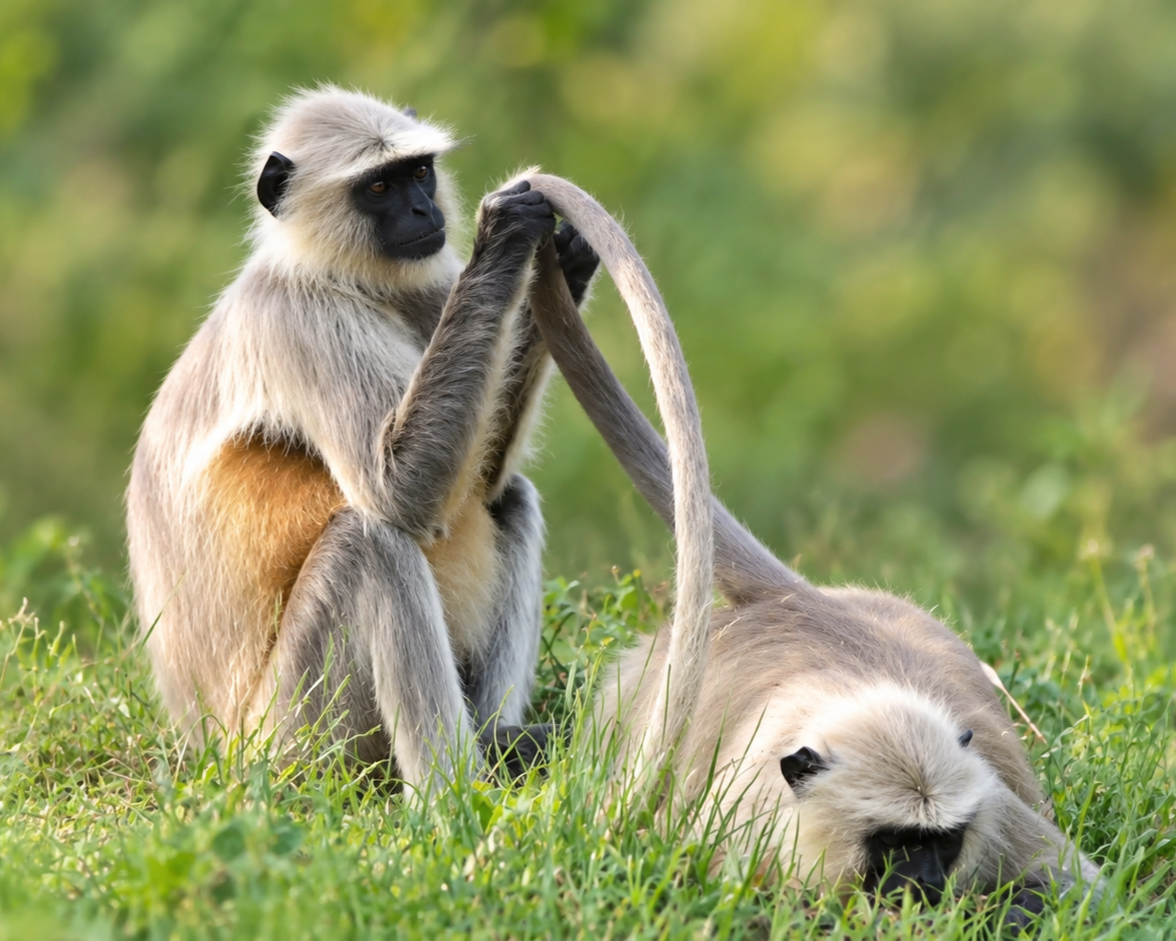

Langurs: A Life in the Canopy (Presbytis entellus: Dufresne now Semnopithecus entellus)
The Langurs are found throughout South East Asia including Southern China and the Indian subcontinent. The habitat includes a wide range of ecological niches ranging from the tropical rain forests to the harsh Himalayan foothills.
They are mostly tree dwelling but some may live on rocks and cliffs. To avoid predation, they sleep on the not so heavy fringes of the upper forest canopy. Heavier predators find it difficult to tread on the fringes. As an adaptation to the arboreal life style and to facilitate rapid movement within trees, the Langur has a highly reduced thumb which is rudimentary. A protruding thumb is a disadvantage as it can get caught up in the branches or be injured while negotiating aerial movements.
They are vegetarians, feeding occasionally on Insects. Interestingly, unlike macaques and baboons, langurs do not have the cheek pouches for storing food but the stomach consists of three separate pouches with one of these, a special pouch for receiving partly chewed food.
The mother child relationship plays an important part in the social development within monkeys and apes. Both are very special to the group. Attachment to the mother creates suitable conditions for social learning within the group.
Leopards are their greatest enemies. The alarm calls of the Langurs on sighting a tiger or leopard are well known in helping locate tigers and leopards. A warning cry from one langur will send the entire troop bolting. It also assists other ground dwelling animals in reacting to the presence of a predator.
Langurs love to spend the hottest hours of the day dosing and resting in some sheltered grove or tree bordered water course. The langur is a more peaceful and sober animal than the Rhesus.
The robust social set up amongst the members of each group gives them maximum advantage in saving them from dangers, providing living room, food and opportunities for reproduction. The intricate social life increases the chance of survival.
In the wild males can live for about 18 years and females for about 30 years. A female may become sexually active at about the age of 3.6 years and bears off springs every two years (some records mention every year). Adult males are the leaders and can only remain leaders of a harem for three to four years after which they are thrown out by the Batchelor groups of males.
Many apes and monkeys can communicate their feelings of pleasure, anger or fear through vocal utterances which are well understood by the troop.
Each troop occupies its own territory ranging from 1.3 to 13 sq. Kms. Predominantly Batchelor Groups have a higher range. The core area is located near the roosting tree.
A very important part of inter communication is ‘Grooming’ or ‘fur picking’. This was earlier believed to be for a hunt of fleas or lice or fragments of skin secretions but it is not generally so. Grooming provides a gentle stimulus or caress which may involve courtship too. Its repeated indulgence suggests a powerful bond between members of the group. This clip describes the process of grooming in all its interesting details including a focused and detailed scrutiny of all the body parts offered for grooming. It almost appears that one Langur was doing a medical examination of the other.
Females may be more engaged in grooming than males. Grooming of males by females also gives the females an opportunity to feed side by side of the males.
Younger individuals may be involved less. Dominant langurs groom one another and receive grooming more often than subordinate Langurs.
Langurs are listed as a species of “Least Concern” on the IUCN List. It was previously listed as near Threatened.
©Srimaa Communication
Credits- Dr. Yashpal Singh, Mrs. Neena Singh and Mr. Manoj Kumar Yadav