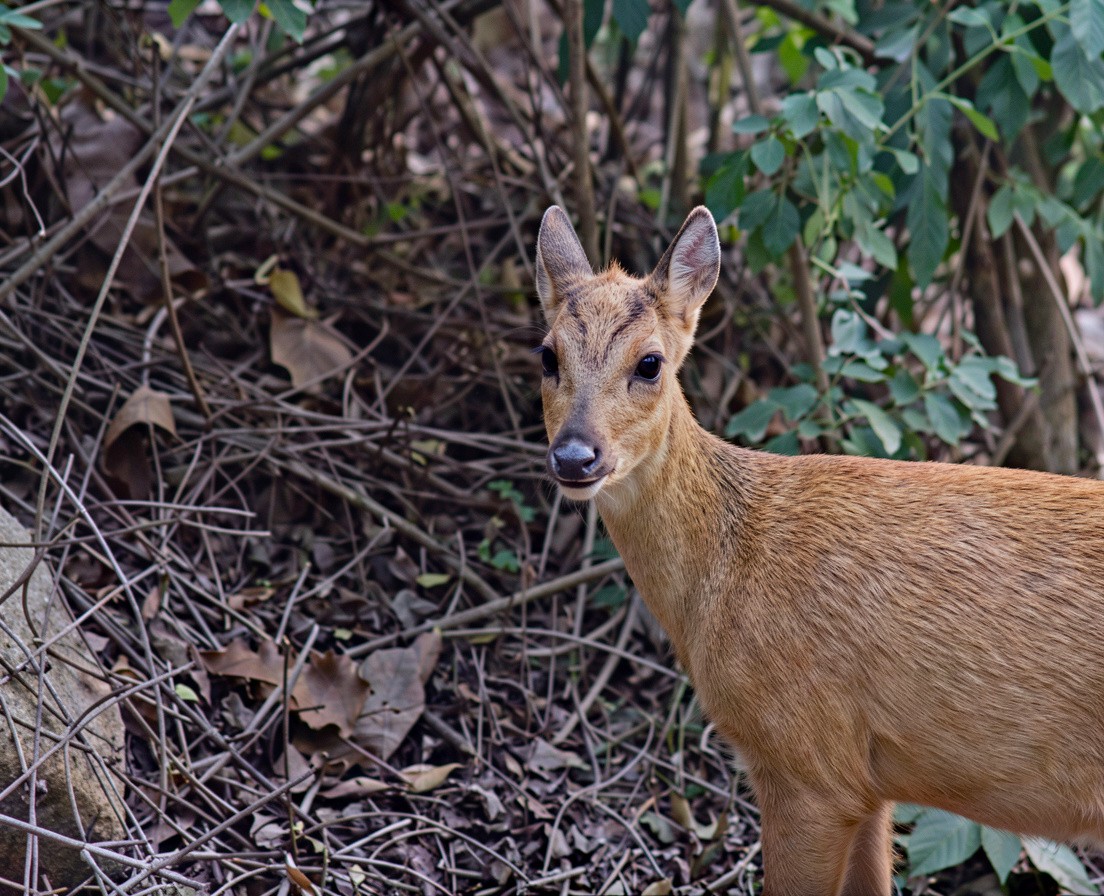

Barking Deer (Muntiacus muntjac)
As we were passing through the Sambar Road in the Dhikala Zone of the Jim Carbett National Park, sometimes in May, I do not remember the year, this female barking deer crossed the road and stopped at the edge. Visibly alarmed, it was stomping its feet frantically. The reason for the alarm was best known to her but being with her for some time, gave us time to observe.
Barking deer (Muntiacus muntjac) males may be about twenty to thirty inches in height and weigh about twenty-five kilogram in adult hood. Females are smaller and lighter. The males may possess protrusive, backward curved canines also called tushes and small antlers which may be about five to nine inches in length inclusive of the pedicel and the horn. These are used in territorial fights. In females, the antlers are replaced by tufts of bushy hair. Tushes are smaller in females. These deer are most often seen singly or in pairs. I was told that unlike other deer species, it does not posses a gall bladder and is a mammal with the smallest number of deployed chromosomes, seven in males and six in females. Its call resembles a Bark and can be heard as far as about one kilometre.
Muntjacs have an evolutionary history of about fifteen to thirty-five million years and are probably the oldest known members of the deer family.
Muntjacs rely on a well-developed sense of smell and mark territory and communicate through secretions produced in scent glands. While most deer possess scent glands below the eyes, the Muntjac possesses an additional scent gland between the eyes. Glands may also be present on the hooves. Males have larger glands than females.
Territory is established through marking with scent produced from these scent glands. Males are also known to use their canines and hooves for this.
Stomping of feet is a defence mechanism when a deer is uncertain about a potential threat. Stomping helps in provoking a reaction from a hidden predator, creates ground vibrations to alert other deer and releases scent from glands in its hooves. In this case, this female had spotted us and we had stopped to film it, but I do not know if we were the only cause of alarm. Stomping also acts as a silent alarm to other nearby deer. After stomping, the deer would either bark to scare away the predator or flies to safety.
Muntjacs are polygamous. Females became sexually active during the first or second year with an oestrus cycle of fourteen to twenty-four days and oestrus lasting two days. The gestation period is six to seven months. Young leave the mothers when about six months old and establish their own territory. Occasionally twin births have been recorded. There is no evidence of a specific breeding season and in this way the Muntjac are different from other even toed ungulates.
©Srimaa Communication
Credits- Dr. Yashpal Singh, Mrs. Neena Singh, Mr. Rajesh Bedi, Manoj Kumar Yadav