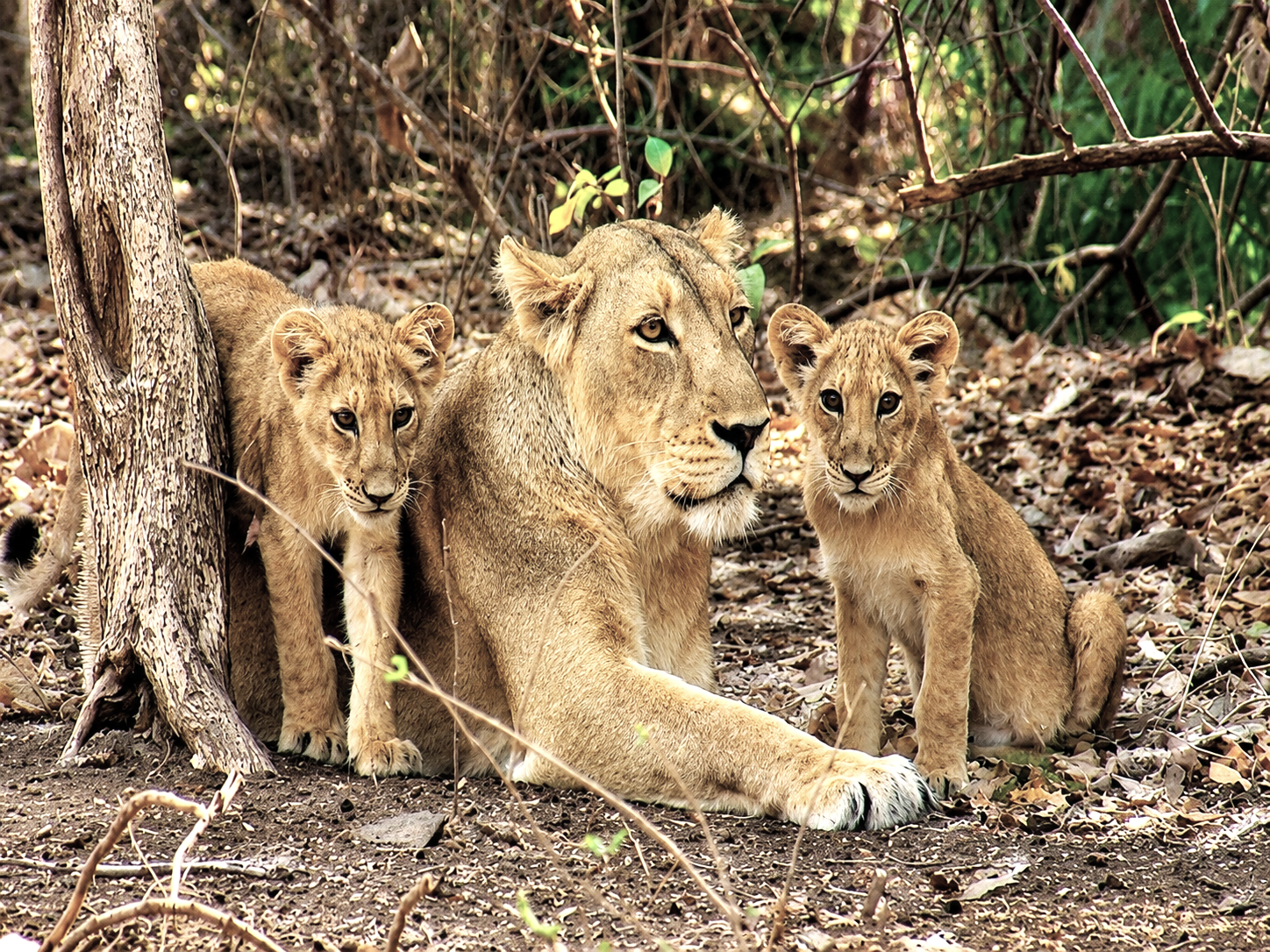

The Asiatic Lion-Conservation, inbreeding, gene loss and sexual behaviour
The Asiatic lion (Panthera leo persica) is a critically endangered species which survives in the wild only in the Gir forest and the adjoining areas of Gujarat, India. Branching out of the African stock some hundred thousand years ago, it entered India some forty thousand years ago, but was entirely wiped out after the middle of the nineteenth century which witnessed large scale exterminations.
In India, only Twelve lions were left in the wild in 1880. It is during this time that the local administrative led by the Nawab of Junagadh stepped in and stopped the indiscriminate killing of lions and introduced focussed conservation efforts to protect and re-establish the species. Today there are about nine hundred lions in the wild at the Gir Forest in Gujarat, India.
The African Lion (Panthera leo) and the Asiatic Lion (Panthera leo persica) being sub species of the same genus can interbreed and produce fertile offsprings but interbreeding is discouraged in order to maintain the genetic identity of the Asiatic Lion.
All Lions in Gir are descendants of the once surviving 12 lions of the area. Inbreeding has caused a weakening of the gene pool which has in turn affected the sexual behaviour of lions.
The female achieves sexual maturity at the age of three years and the male between 5 to 8 years. Both remain sexually active till the age of 15 years. A mating pair generally gets isolated to concentrate on courtship. There is no particular breeding season in Indian Lions. Mating can take place any time of the year. In Gir most lions mate between October and November.
Because of the weak gene pool, the frequency of copulation is higher than in African lions. The Lions of Gir also have a very poor-quality sperm. 70 % to 80 % of the sperms are deformed. Mating lasts for a couple of days.
The gestation period is about 116 days and the young are generally produced at intervals of about 2 years.
The blind and helpless cubs are well hidden from predators. Ordinarily the litter number is two, sometimes three or up to five.
The cub’s mortality rate is high in the first six months. Often a new male lion will kill and eat the cubs sired by other males. This reinstates oestrus in the lioness which then becomes available for mating.
The mother looks after the cubs, who remain with her for almost two years. The period of lactation is not defined. Weaning may be initiated at about 4 to 6 weeks and finish by about 5 to 6 months. The early 5 to 6 weeks is a period of complete dependence on mother’s milk after which small prey fragments could be supplemented.
©Srimaa Communication
Credits- Dr. Yashpal Singh, Mrs. Neena Singh, Mr. Rajesh Bedi and Mr. Manoj Kumar Yadav