
The Environment Audit Rules 2025. Strengthening the Compliance verification mechanism
The Government of India considered it important that an Environmental Audit of projects approved under the Environment Protection Act 1986, or Air (Prevention and Control of Pollution) Act 1981 or the Water (Prevention and Control of Pollution) Act 1974 or the Van (Sanrakshan Evam Samvardhan) Adhiniyam, 1980 and Wild Life (Protection) Act 1972 is necessary to verify compliance to conditions and standards prescribed therein.
It was expected that such audits would help in identifying violation cases, encourage self-compliance, enhance overall environmental responsibility and resource efficiency and productivity, and also provide inputs in undertaking suitable measures towards conservation and rejuvenation of environment and for fulfilling the Governments obligations towards adopting the principles of life style for environment including best practices for better environmental performance.
The Government wished to create an enabling infrastructure for the same and provide for the registration of such environmental auditors who would also act as ‘Designated Agency’ under the Green Credit Rules 2023 and ‘Verifiers’ or ‘Auditors’ under various subordinate legislations under the various environmental laws.
This was not to be a substitute to the existing compliance monitoring system but act as a supplement.
The MoEF and CC has notified the Environment Audit Rules, 2025 on 29-8-2025 which have come into effect from 29-8-2025. Link 1 The said rules make the following provisions.
Rule 2.
Definitions are provided under Clause 2 of the Rules, which also include ‘Certified’ and ‘Registered’ environmental auditors.
- “Act” means the Environment (Protection) Act, 1986 (29 of 1986);
- “Administrator” means the Administrator referred to in rule 7 of Green Credit Rules, 2023; c. “Certified Environment Auditor” means an individual certified by the Environment Audit Designated Agency as qualified to undertake environment audits and for performing such other functions;
- “designated agency” means an entity designated as such under rule 13 of the Green Credit Rules, 2023;
- “environment audit” means a systematic audit, verification, examination, inspection, or analysis of any project, activity or process having a bearing on the environment, and undertaken by the Registered Environment Auditor;
- “Environment Audit Designated Agency” means the agency or agencies, as notified by the Central Government from time to time, responsible for overall management of the Environment Audit including drawing up eligibility criteria, conducting examination for the certification, registration of Certified Environment Auditors, monitoring of their performance, trainings and capacity building; “green approvals” means any approval, clearance, authorisation, licence, or permission granted under the Environment (Protection) Act, 1986, the Air (Prevention and Control of Pollution) Act, 1981, the Water (Prevention and Control of Pollution) Act, 1974, the Van (Sanrakshan Evam Samvardhan) Adhiniyam, 1980, the Wild Life (Protection) Act, 1972 or under any other applicable rules, regulations, notifications, or orders issued by the Central Government or any State Government from time to time;
- “guidelines” means the guidelines issued from time to time by the Central Government under these rules;
- “National Certification Examination” means the examination conducted by the Environment Audit Designated Agency or by any other agency engaged by Environment Audit Designated Agency after due approval of the Central Government for the purpose of certifying Environment Auditors;
- “Registered Environment Auditor” means a certified environment auditor or a firm or a body corporate comprising two or more certified environment auditors, who meet the criteria for registration as specified in the guidelines and are registered by Environment Audit Designated Agency for undertaking environment audits and for performing such other functions as may be prescribed by the Central Government from time to time.
(2) Words and expressions used in these rules and not defined herein, but defined in the respective Acts, shall have the meanings respectively assigned to them in the said Acts.
Rule 3.
Registered Environmental Auditors (REA), as part of their roles and responsibilities shall undertake environment audit, conduct sampling and analysis, evaluate the adequacy of pollution control and waste management systems, report violations, compute environmental compensation. The REA’s would also prepare and submit environment audit reports, verify activities related to Green Credit Registry (as a designated agency under the Green Credit Rules (2023), undertake environmental audits as assigned by the CPCB (either directly or through a designated agency), the CPCB or the competent authority under the Eco Mark Rules 2024, & the competent authority under the E.I.A. notification 2006, CRZ notification 2011 and CRZ notification 2019.
The REA would also verify all self-compliance reports submitted by the projects, activities and processes and also perform any other function that may be specified or directed by the Central Government from time to time.
Rule 4.
In the fulfillment of its duties, the REA would have the authority to inspect, collect samples and seek information with respect to cases assigned to it by the Central Government.
Rule 5 and 6.
The notification creates an “Environment Audit Designated Agency (EADA)” for the overall management of the environmental audit including certification and Registration of Auditors. The National Productivity Council has been designated as the EADA.
Rule 7.
The certification of auditors has been provided to be carried out either through a ‘Recognition of prior learning’ which is based on prior experience and expertise or a structured examination process for assessing eligibility for certification.
Rule 8.
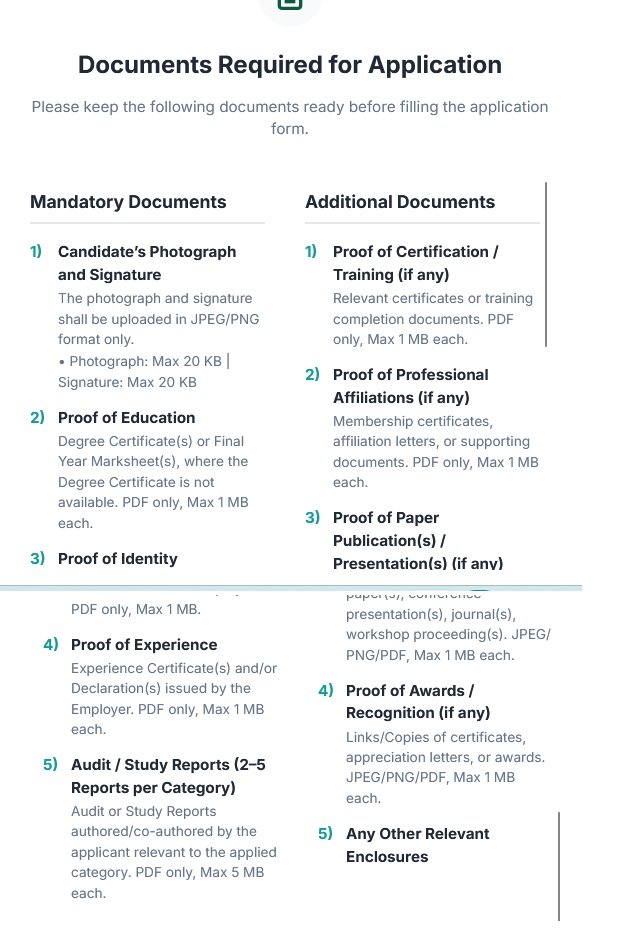
Detailed procedures are provided in the Guidelines issued by the Central Government (Link 2) for the mechanism of Registration of Certified Environmental Auditors. Documentation requirements have been provided by the EADA (Links 4)
Rule 10.
The Environmental Audit Designated Agency and the Registered Environmental Auditor. Registered Environmental auditor shall have operational autonomy and shall act in accordance to the rules, regulations and guidelines specified by the Central Government.
Rule 11.
The Central Government shall issue guidelines on the ‘Code of Conduct’ to be followed by the Certified Environmental Auditors and the Registered Environmental Auditor and no action shall be taken without affording an opportunity to be heard.
Rule 12.
The Registered Environmental Auditor shall not be related to the owners, operator, occupiers or project proponents. This includes business partnerships, employees, contractual associates, outside the audit, spouses, partners, siblings, parent or child.
The Registered Environmental Auditor should also have no pecuniary interest in the project or process to be audited or in the holdings of the company, its subsidiaries or associate companies. They should also not have provided any services (other than independent review of audit) to the project such that they audit their own work. The registered auditor would be to accept any inducements, gifts etc. from the auditee, its employees or any interested party and not knowingly permit colleagues to do so.
Importantly, the REA is not permitted to undertake any environmental audit of a project for whom the REA has prepared the EIA report, EMP or prepared any report which is the subject matter of the environmental audit.
Adequate undertakings shall be submitted.
Rule 13:
Specific projects or activities shall be assigned to the Registered Environmental Auditor on a random assignment method.
Rule 14:
Fee shall be fixed as may be decided by the Central Government and shall be binding. Guidelines (Link 3) have been prescribed.
Rule 15:
A Steering Committee shall be constituted to oversee the implementation of the scheme, including review and amendments. This shall be chaired by the Additional Secretary, MoEFCC. (GOI)
Rule 16:
The Central Government has been empowered to issue directions to the EADA or REA and the same will be bound to comply.
In the event of any conflict between the audit report submitted by an REA and an audit report submitted by an officer or official of the Central or State Government, the latter shall be deemed to be final after approval of the Joint Secretory or equivalent-level officer in charge of Environmental Audit.
The role of the Pollution Control Board, not being part of the offices of the Central or State Government, may need more clarification. What if the Pollution Control Board reports differ from the audit done by REA.
Rule 18:
The Central Government is vested with powers to issue guidelines. Guidelines (link 2 and link 3) have been issued .
A maximum age limit of 70 years has been prescribed for individuals to apply as Certified Environmental Auditors. It does not appear clear whether the age restriction would apply to retired Government Officials as it is not mentioned in the eligibility criteria at 4.5. of the guidelines. (Link 2) The REA shall have access to recognized laboratory facilities.
The Central Government has also published guidelines for fee structure under Recognition of Prior Learning mode. A fee of Rs. 25,000/- has been provided for Certified and Registered Auditors respectively. These guidelines (Link 3) also prescribe the audit cost structure, including professional audit fees, institutional charges, accommodation charges, travelling expenses etc. along with an institutional charge 6.25% to be paid to the EADA on professional audit fee alone.